

Most parking lots do not need one big fix. They need the right fix for each problem: cracks get filled, potholes get patched, worn but sound surfaces get sealcoated, failed areas get resurfaced, and faded lines get restriped. Bull's Eye offers all of those services, so a lot can be sorted by what is actually wrong with it. This page helps you read the damage, match it to the repair, and plan the work around an occupied property.
What's Included
- Pothole repair, with same-day repairs for most pothole jobs
- Hot-pour rubberized crack filling before any sealcoating
- Two-coat sealcoating for sound pavement that is aging
- Asphalt overlay for surfaces too worn for sealer to help
- Parking lot striping, ADA striping and signage, wheel stops and curb painting after repairs
- Phased, overnight or weekend scheduling for commercial and HOA lots
Start With the Symptom, Not the Service
The most common parking lot repair mistake is buying a fix that does not match the problem, such as sealcoating over a failing base or patching a lot that needs resurfacing. Walk the lot and note what you see. The table below maps each common symptom to the usual repair and to the Bull's Eye service that covers it. Terms follow the Federal Highway Administration's Distress Identification Manual, which defines pavement distress types in plain language.
| What you see | What it usually means | Usual fix |
|---|---|---|
| Thin, single cracks, hairline to about a finger wide | Surface aging or movement; water can now reach the base | Crack filling, then sealcoat if the surface is otherwise sound |
| Bowl-shaped holes | Water got into the base and traffic broke the surface above it | Pothole repair and patching; look for the cause |
| Alligator cracking: small interlocking cracks in a pattern | The FHWA manual defines it as failure of the asphalt surface under repeated traffic loading | Patch the area properly or resurface if widespread; sealer will not fix it |
| Gray, rough, sandy surface with loose stones | Aging and raveling: aggregate working loose from the surface | Sealcoating if early; overlay if advanced |
| Standing water after rain | A low spot or drainage problem; water speeds up damage | Find the cause first; a patch or overlay may correct the grade, but a drainage fix may be needed |
| Crumbling at the pavement edge | Edge failure from lack of support or water at the perimeter | Edge patching; overlay if the whole lot is aged |
| Faded or missing lines, worn symbols | Paint wear | Parking lot striping |
| Raised, sunken or broken spots near accessible spaces or curbs | Trip hazard and possible ADA problem | Prompt patching; see ADA striping and signage and ADA parking lot requirements |
The Problems, One at a Time
Potholes
A pothole is a bowl-shaped depression in the surface, and it usually means water has already weakened the layer below. Research from the Strategic Highway Research Program, summarized by the FHWA, found that simple throw-and-roll patching performed as well as more elaborate methods, and that material quality was key to how long patches lasted. In practice, that means a quick patch can be a legitimate fix when done well, but a repeat pothole in the same spot points to a base or drainage cause worth finding. Bull's Eye handles most pothole jobs with same-day repairs. See pothole repair and patching.
Cracks
Cracks are small now and expensive later. The goal of any crack treatment is to keep water out of the layers below, because water weakens the base and leads to potholes. Hot-pour rubberized crack sealing is the method Bull's Eye uses, and it comes before sealcoating, since sealer alone does not bridge an open crack. Widespread cracking that is connected into a network is a different problem, covered next. See crack filling and sealing.
Alligator cracking
Alligator cracking is a structural warning, not a cosmetic one. If the cracks are interlocked and the surface moves or sinks under foot or tire, filling them is only a temporary measure. Small failed areas can be cut out and patched. If the pattern covers much of the lot, an overlay or new paving is usually the better use of money. Ask any contractor how deep they plan to go and why.
Ponding and drainage
Standing water is one of the clearest signs a lot is aging faster than it should. It keeps the surface wet, and moisture that gets into the base weakens it. A National Academies guideline on pavement moisture notes that a surface treatment will not solve a moisture problem if the main source of water is somewhere else, so cause matters. Mark where water sits after a storm, take photos, and show them to the contractor at the estimate. South Florida's rainy season runs roughly from late May to mid-October, according to the National Weather Service in Miami, so ponding is easiest to see then.
Raveling and edge failure
Raveling is the wearing away of the surface as aggregate particles come loose, per the FHWA definition. A surface with loose stone and a rough, gray look is usually aging, and early on it is the classic sealcoating candidate. Edge failure is damage along the pavement perimeter, often where water collects or support is weak. Both are better handled early; both turn into patching or resurfacing jobs if ignored.
Faded striping
Faded lines are the easiest repair and often the most visible one. They affect parking flow, accessible spaces and fire lane markings. Restriping after repairs and sealcoating keeps the layout crisp. See parking lot striping, fire lane painting and curb painting.
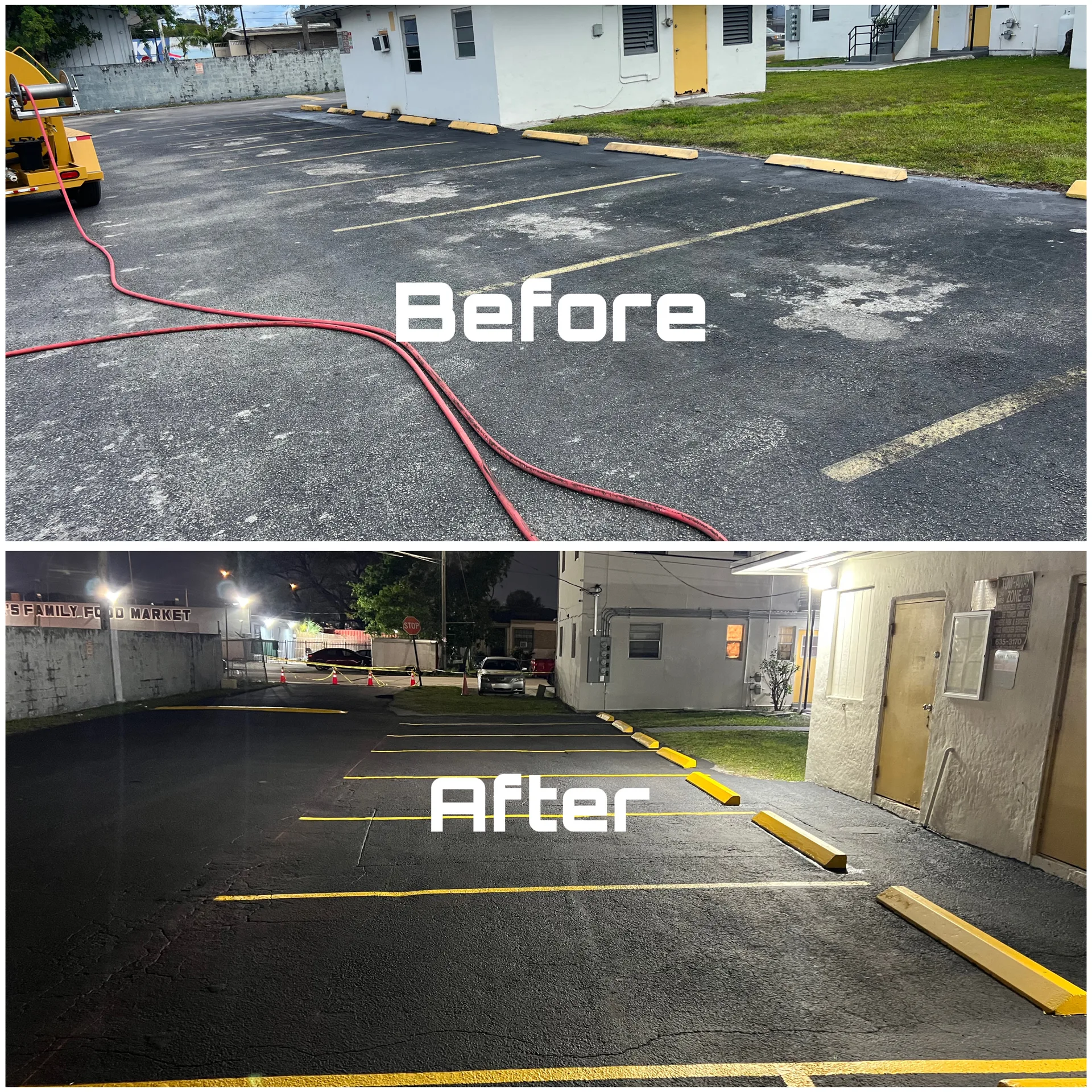
Before and after: sealcoating and restriping a commercial lot.
Trip Hazards, ADA and Owner Responsibility
A damaged parking lot is a safety and compliance issue as well as a maintenance one. The 2010 ADA Standards say ground surfaces on accessible routes must be stable, firm and slip resistant, and limit vertical changes in level: up to 1/4 inch is permitted, changes between 1/4 and 1/2 inch must be beveled, and anything larger needs a ramp. A cracked or heaved patch at an accessible space or curb ramp can therefore be a compliance issue as well as a trip hazard. Treat spots near accessible spaces as priority repairs.
Miami-Dade County also publishes standards for commercial property. Its commercial potholes page says potholes on commercial properties cannot exceed five square inches in size or two inches in depth under County Code section 19-15.3, and says owners should hire a licensed contractor who can obtain the required permits to apply a seal coat, re-stripe or resurface a lot under section 19-15.4. Its parking area surface page adds that striping must be visible to the driver and wheel stops must be intact and in place. The county says enforcement is complaint-based, with a courtesy warning first and civil citations after non-compliance or repeat offenses. These pages describe county rules; Cutler Bay is an incorporated municipality, so confirm which rules apply to your property, and confirm current figures, with the county or town. This is general information, not legal advice. The county lists a parking lot and paving line at 786-315-2707.
- Walk the lot on a regular schedule and keep dated notes and photos of what you found and what was repaired. Good records help show the property is being looked after.
- Mark or cone off a hazard you cannot fix the same day.
- Ask any contractor whether permits are needed for the work, and who pulls them.
- Ask your insurance adviser or attorney about liability questions; a paving contractor cannot answer those.
Repairing an Occupied Lot in Phases
Customers, tenants and deliveries do not stop while a lot is repaired, so the work is usually split into sections. Bull's Eye schedules commercial and HOA work in phases and can work overnight or on weekends, and works with HOA boards and property managers. One customer wrote that Bull's Eye “worked with our staff and tenants and made the sealcoating and striping job very easy.” A workable plan usually covers the points below.
- Walk and mark the lot. Agree on which areas get which repair, and which areas must stay open.
- Divide into zones. Close one section at a time, keeping the entrance, accessible spaces and fire access available where possible.
- Repair first. Patching and crack filling go in before sealer, so they are done and set.
- Notify in advance. Give tenants, staff and delivery drivers written notice of which sections close and when, with barricades and signs on the day.
- Seal and stripe. Sealcoating and striping can happen in the same visit, followed by wheel stops and curb or fire lane marking if needed.
- Reopen after the stated cure time. Ask the contractor how long each section stays closed before you tell tenants.
For HOA and condo properties, see the guide on HOA and condo parking lots; for rental communities, apartment complex parking lots.
Repair, Seal or Resurface? A Quick Decision Guide
- Mostly sound with minor cracks and fading: fill cracks, sealcoat and restripe.
- Sound overall with a few failed spots: patch those spots, then seal and stripe.
- Widespread alligator cracking, many potholes, or surface breaking up: price an overlay or new paving, because small repairs will keep returning.
What to Ask Any Parking Lot Repair Contractor
- Will you walk the whole lot and mark every area on a plan before quoting?
- Is each repair listed separately with its area and method, so I can compare bids line by line?
- How will you repair potholes: cut out and replace, or patch over? Why?
- Are cracks filled before sealcoating?
- How will you handle the standing water areas?
- How will you keep the lot open, and when are sections closed?
- Do you carry general liability insurance, and can I see proof? Bull's Eye carries it and provides proof on request.
- Who pulls permits, if any are needed?
Be wary of an estimate that is one lump sum with no scope, or a recommendation of sealcoating for a lot that is clearly failing.
What Affects the Price
Repair cost depends on the total area, how many cracks and potholes there are, the depth of repairs, whether resurfacing is needed, access, and how much phasing the lot requires. Prices found online range too widely to rely on, so the only number that matters is the one for your lot. Bull's Eye provides it through a free, no-obligation on-site estimate.
Serving Cutler Bay and Nearby Communities
We are based at 8260 SW 184th St in Cutler Bay and serve Palmetto Bay, South Miami Heights, Goulds, Naranja, Princeton, Perrine and West Perrine, Richmond Heights and Richmond West. See all service areas, including Cutler Bay.
Get a Free Parking Lot Repair Estimate
Call (305) 710-4512 or request your free on-site estimate. We are open Monday to Friday 7 to 5 and Saturday 8 to 12. Another customer called us “Fast and Professional.” More answers are in our FAQ.


