

Sealcoating adds a protective layer over an asphalt driveway that slows UV oxidation, keeps oil and gas from soaking in, and sheds water, so the surface lasts longer and looks uniformly dark again. Bull's Eye cleans the surface, primes oil spots, hot-pour fills cracks, then applies two coats. Not every driveway needs it yet: if the pavement is too far gone or too new, sealcoating will not pay off.
What's Included
- Surface cleaning so sealer bonds to clean asphalt
- Oil and gas spot priming before any sealer goes down
- Hot-pour rubberized crack filling completed before sealcoating
- Two-coat sealcoat application for even, full coverage
- Clean, straight edges along the garage, curb and walkways
- Free on-site estimate with no obligation
Does Your Driveway Actually Need Sealcoating?
Sealcoating is maintenance, not a repair. It works best on asphalt that is still sound but has started to age. The Asphalt Institute notes that a well-built low-traffic driveway should not need sealing for roughly 2 to 5 years, and recommends sealing once signs of wear appear: dry or brittle surface, small cracks, open surface texture, or loose stone. Here is how to read what you see.
| What you see | What it usually means | Best next step |
|---|---|---|
| Deep black, smooth, no cracks (under a couple of years old) | Healthy, young asphalt | Wait. Sealing too early is a common mistake. |
| Gray or faded, rough and sandy to the touch | UV has oxidized the binder at the surface | Good sealcoating candidate |
| Hairline and small cracks | Water can reach the base | Crack filling, then sealcoat |
| Oil stains and dark drip spots | Petroleum softens asphalt | Spot prime, then sealcoat |
| Wide cracks, alligator (interlocking) cracking, soft or sunken areas | Base or structural problem; sealer will not fix it | Patching or resurfacing |
What Florida Does to a Driveway
South Florida's rainy season generally runs from mid-May through mid-October, according to the National Weather Service in Miami, and most of the year's rain falls in that window. Add strong year-round sun and heat, and an unprotected driveway faces two things at once: UV that dries out the surface binder, and repeated water exposure at every crack. Sealcoating helps against both, which is why it is worth timing around the weather. The scheduling section below explains how.
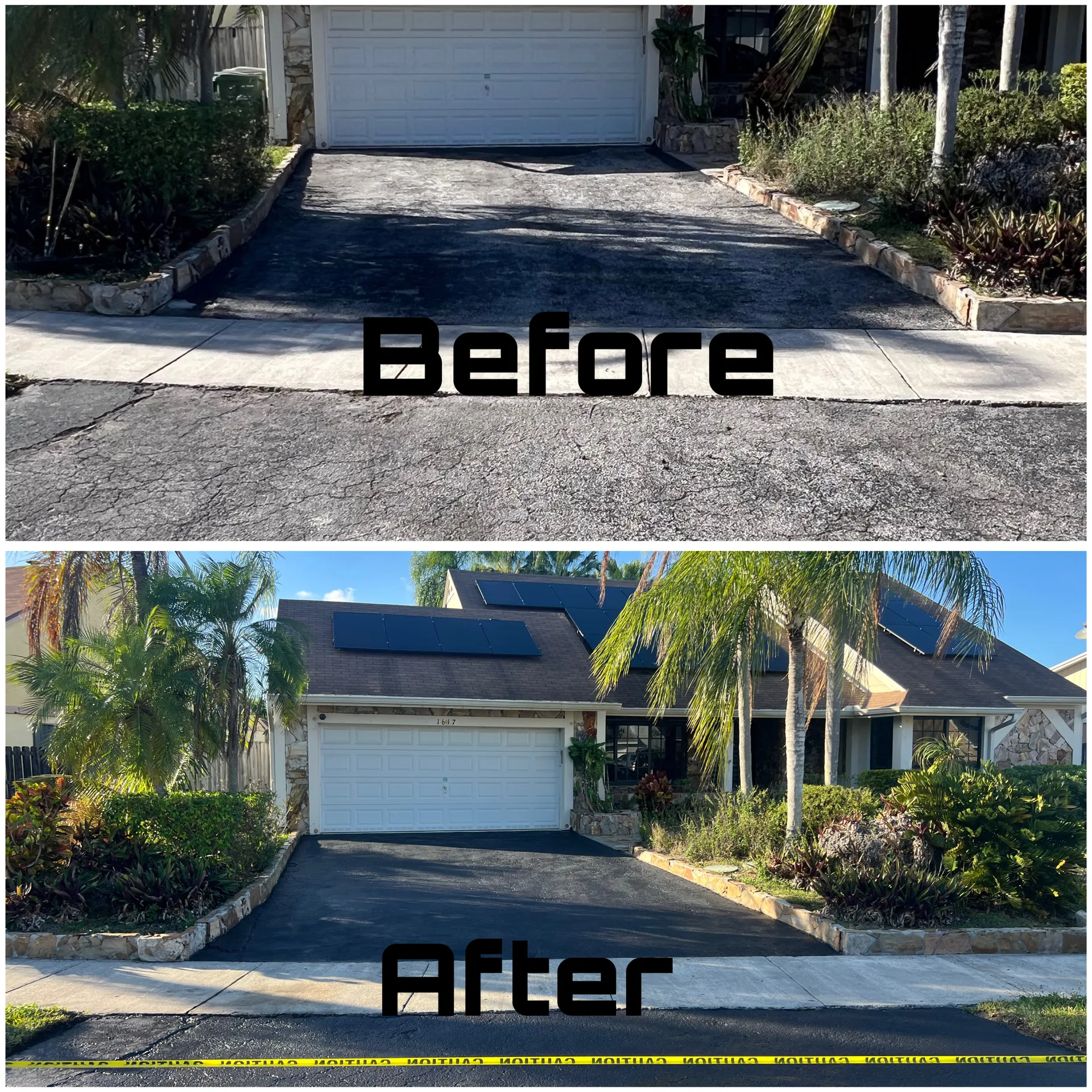
A faded driveway before and after sealcoating in Cutler Bay.
What a Proper Driveway Sealcoat Job Includes
- Walk-through and measure. A good estimate starts with a look at the surface, drainage, cracks and oil spots, plus a measurement of the area, so the price reflects your actual driveway. Bull's Eye offers this as a free on-site estimate.
- Clean the surface. Dirt, leaves and loose debris need to come off. Sealer sticks to clean asphalt, not to dust.
- Prime oil and gas spots. Petroleum stains are cleaned and primed so they do not bleed through or keep sealer from bonding.
- Fill the cracks. Hot-pour rubberized crack filler goes into cracks before sealcoating, because sealer alone does not bridge an open crack. See the crack filling and sealing page for how that works.
- Edge cleanly. Edges along the garage, curbs and walkways should be lined up so the finished line is straight.
- Apply two coats. Two coats give more even coverage than one heavy pass.
- Follow the cure guidance. Fresh sealer needs time before traffic. The next section covers what to expect.
Cure Time and Rain: What to Expect
Trade guidance and public agency specifications agree on a few basics: apply to dry pavement when the surface and air are at least about 50°F and rising, and avoid applying when rain is expected within roughly 24 hours. Drying and cure slow down in cooler, more humid conditions and speed up in warm, dry, breezy ones. Most contractors and HOA notices ask for about a day off the surface before regular vehicle traffic. Exact timing depends on weather and coverage.
- Keep cars, bikes, scooters and pets off until the surface is ready.
- Turn off sprinklers that hit the driveway the morning of the job and overnight.
- Avoid sharp turns with the steering wheel while parked in the first days; fresh sealer can scuff.
- Footprints and slight tire marks in the first days are normal; deep tracking or a sticky surface after the stated cure time is not.
When to Schedule in South Florida
The ideal job day is dry, warm and followed by a rain-free night. In Cutler Bay, the rainy season makes those windows harder to find from late spring into early fall. Dry-season months give the most dependable windows, but a dry stretch in any month can work. Good practice is to move a job rather than gamble on a pop-up storm, since a reschedule protects the result.
Questions to Ask Any Driveway Sealcoating Contractor
Homeowner complaints found online repeat the same themes: surprise price increases, sealer that peels or stays sticky, diluted product, and crews who disappear after cashing the check. Ask any contractor these questions.
- Will you walk the driveway and give an estimate with the scope and price before work starts?
- Are cracks filled before sealing, and how?
- How many coats, and how is the sealer applied? Brushed or squeegeed coats are generally preferred on residential driveways over thin spray passes.
- Is the sealer thinned, and with what? Only water, within the manufacturer's limits.
- What is the cure time, and who do I call if something looks wrong?
- Do you carry liability insurance? Bull's Eye carries general liability insurance, and proof is available on request.
What Sealcoating Will Not Do
Sealcoating does not repair a failed base, stop tree-root heave, or hide deep cracks. It does not make a driveway permanent, and it is not required for the asphalt to function. What it does is slow surface aging and make a sound driveway easier to keep clean and consistent in color. For widespread cracking or sinking, an overlay or new paving is a better use of money.
What Affects the Price
Driveways vary, so there is no flat price. The main drivers are total square footage, the amount of crack filling, oil spots and patching needed, the number of coats, access, and how easy it is to work around landscaping and vehicles. Ranges online vary widely, so the only number that matters is the one quoted for your driveway. Bull's Eye provides that estimate free, with no obligation.
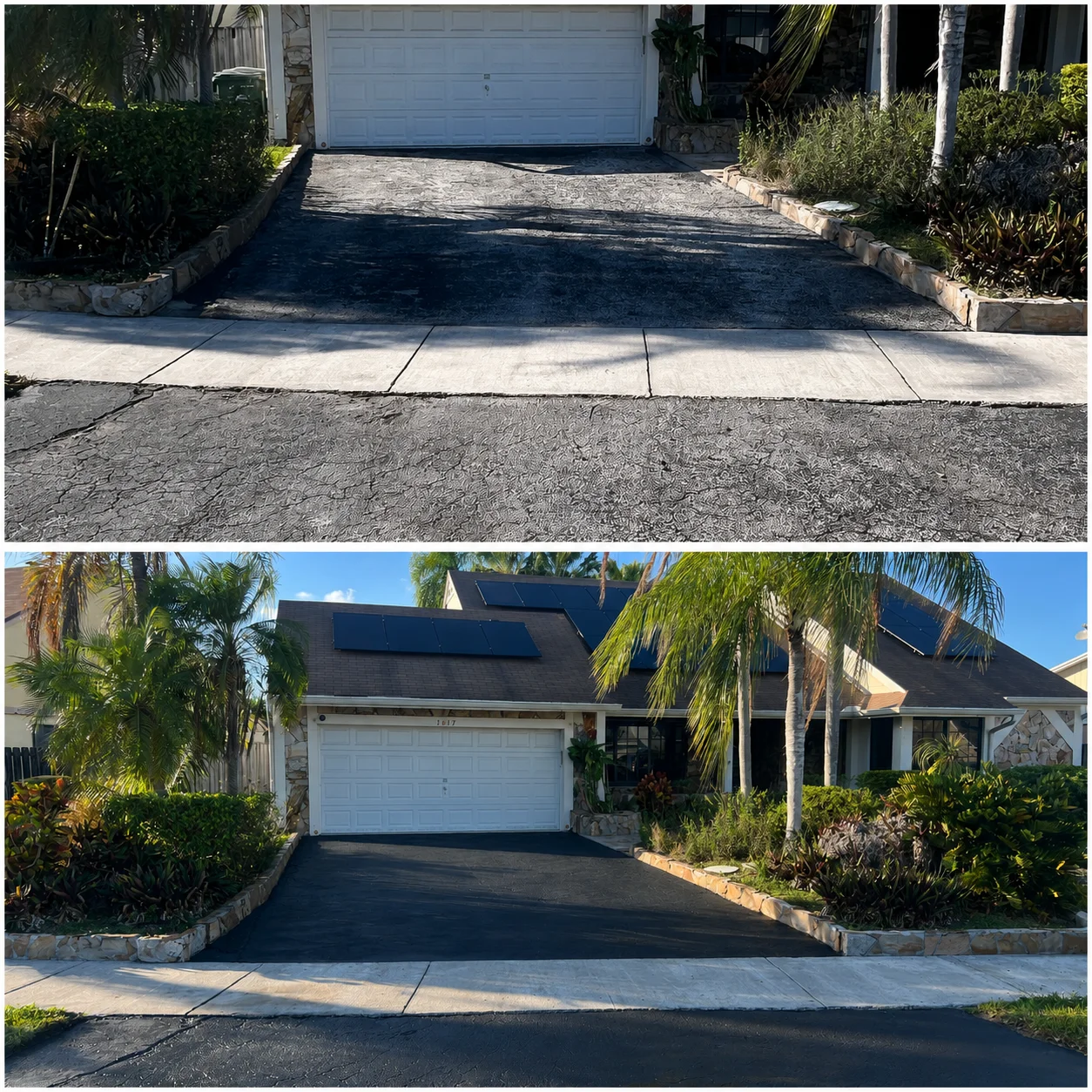
Residential driveway sealcoating, before and after.
Serving Cutler Bay and Nearby Communities
We are based at 8260 SW 184th St in Cutler Bay and serve Palmetto Bay, South Miami Heights, Goulds, Naranja, Princeton, Perrine and West Perrine, Richmond Heights and Richmond West. Not sure if you are in range? Just call.
Get a Free Driveway Estimate
Call (305) 710-4512 or request your free on-site estimate. We are open Monday to Friday 7 to 5 and Saturday 8 to 12. One of our customers described us as “Fast and Professional.” For more answers, see our FAQ. Managing a lot or an HOA? See commercial and HOA parking lot sealcoating.


