

An asphalt overlay puts a fresh layer of asphalt over an existing driveway or parking lot, and it works only when the pavement underneath is still structurally sound. If your surface is faded, rough, or has surface cracking but doesn't flex under traffic or hold standing water, resurfacing can restore it for less than a full tear-out. A site visit is the reliable way to find out whether an overlay will hold and what it would take. Free, no-obligation on-site estimates.
What's Included
- A proper overlay starts with the existing surface cleaned, repaired, and prepped
- Cracks, failed patches, and soft spots need to be addressed first so they don't show up in the new layer
- A new asphalt layer over the prepped surface gives a smooth, uniform finish
- Grade and slope should be reviewed so the overlay can help water drain instead of pond
- Free on-site estimate to help decide between overlay, repair, or full replacement
- Parking lot striping is available after resurfacing so the lot is ready to use
What an Asphalt Overlay Is (and Isn't)
An overlay, sometimes called resurfacing, is a new layer of hot asphalt placed on top of existing pavement after the surface has been cleaned and repaired. Federal Highway Administration guidance describes thin overlays as a way to improve ride, correct rutting, and make a pavement less permeable, and it is explicit that they extend the life of a pavement rather than add structural strength. That one distinction explains almost every good or bad overlay outcome: the new layer is only as sound as what it sits on.
So an overlay is not a cure for a failing base. It is a resurfacing treatment for pavement whose structure is still doing its job.
Overlay, Sealcoat, Patch, or Replace: Which One Do You Need?
Most property owners ask for an overlay when what they really want is a surface that stops looking and acting worn out. Use this table as a starting point, then let a site visit confirm it.
| What you see | What it usually points to | Typical fit |
|---|---|---|
| Gray, faded surface, a few hairline cracks, no soft spots | Oxidation and light surface wear | Sealcoating with crack filling |
| A handful of potholes or small broken areas, rest of the surface firm | Isolated failures | Patching |
| Rough, worn, widespread surface cracking, but the pavement is firm and drains | Aged surface over a sound base | Overlay (resurfacing) |
| Interconnected "alligator" cracking, sections that flex or pump, repeated pothole failures | Base or subgrade failure | Removal and new paving |
| Water ponds after every storm and the low spot is wide | Settlement or grading problem | Regrade; overlay only if the base is sound and the slope can be corrected |
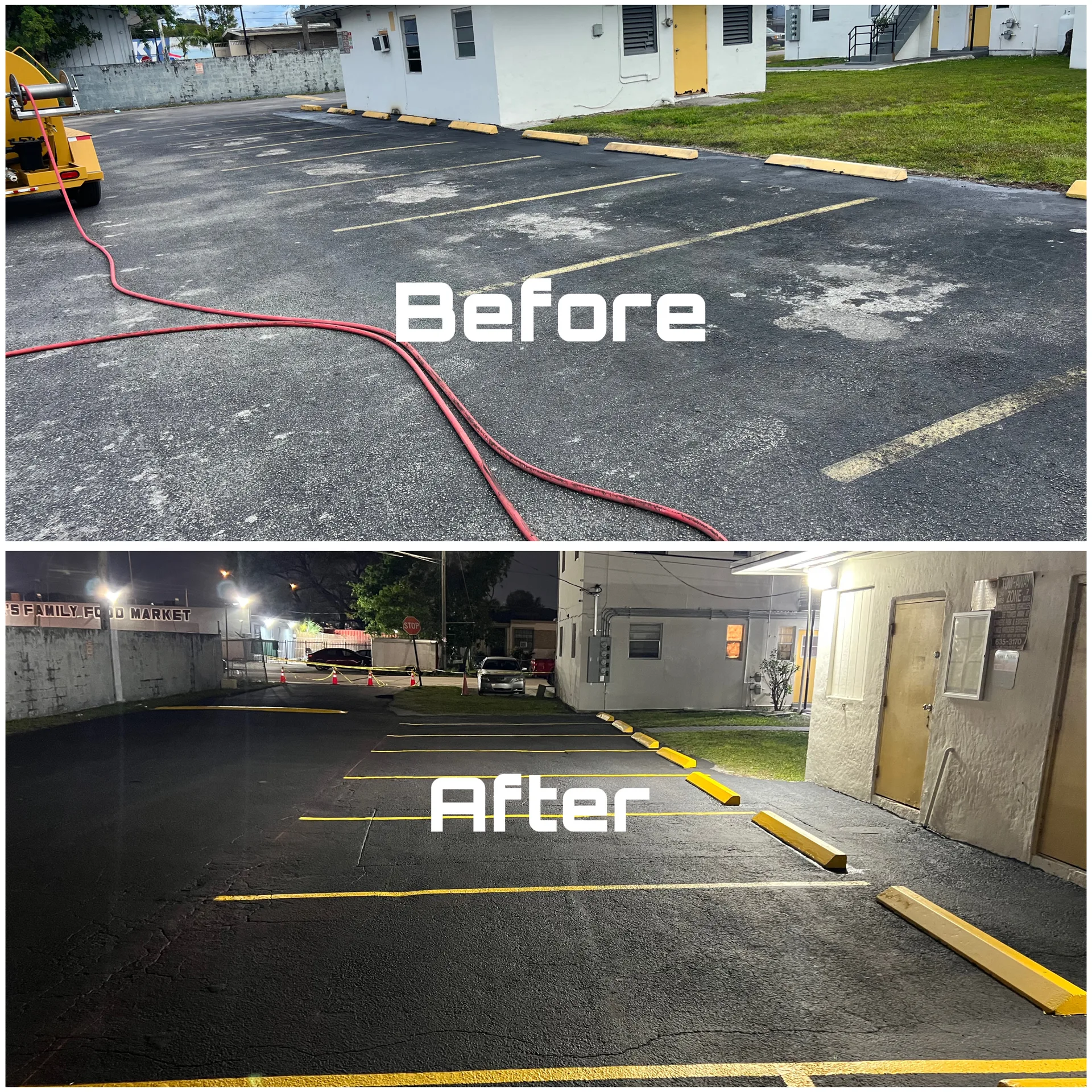
A worn lot before and after. Surface maintenance is often enough when the pavement is still firm; an overlay is the next step up when wear is deeper.
Signs Your Pavement Is a Good Overlay Candidate
- The surface is firm underfoot and under vehicles, with no spongy or bouncing areas.
- Cracking is mostly narrow and limited rather than interconnected across large areas.
- Water drains off the surface instead of sitting in the same places.
- Past repairs have held up instead of failing again and again.
- The main complaints are appearance, roughness, and surface wear.
Signs an Overlay Will Disappoint
- Alligator (fatigue) cracking or sections that move under load. FHWA's guidance on thin overlays calls for full-depth repair or removal of fatigue cracking before overlaying, not a thin cover over it.
- A pattern of cracks that has already been overlaid before. Cracks in the old pavement reflect up through new asphalt, and FHWA specifically warns that moderate or severe cracking patterns will quickly reflect through a thin overlay.
- Widespread raveling or delamination, where the surface is breaking apart rather than just aged.
- A base that stays wet. In Florida, where the water table is high and the rainy season runs roughly May 15 to October 15 according to the National Weather Service, a saturated base is the most common reason pavement fails from below.
How a Proper Overlay Is Done
The new asphalt is the visible part. The quality is mostly in the steps before it:
- Evaluate the pavement. Walk the surface, check how it drains, and mark soft spots, alligator cracking, and failed patches.
- Repair what will not survive an overlay. Failed areas are cut out and rebuilt, and cracks are treated first. Skipping this is how an overlay develops the same cracks within months.
- Clean the surface. Dirt, vegetation, and loose material are removed so the new layer can bond.
- Apply tack coat. A thin asphalt emulsion bonds the new layer to the old one. Without a bond, layers can slip and crack where vehicles turn.
- Place and compact the new asphalt. Hot mix is spread to the planned thickness and slope, then compacted. Thickness and grade at edges, drains, and doorways are set so the finished surface still drains.
- Cure, then finish. After the pavement cools and sets, striping and signage can follow, and a sealcoat is typically added later as the maintenance cycle starts over.
Common Overlay Problems and How to Avoid Them
Cracks that come back through
Reflective cracking is the top complaint after a rushed overlay. It is mostly a prep issue: cracks and failed areas that were covered instead of repaired. Ask what will be done about them before the asphalt arrives.
A surface that sits higher
An overlay raises the pavement. At a driveway, that can change the slope toward a garage or the transition at the street apron. In a lot, it can affect curbs, drains, and thresholds. These details should be settled before work starts.
Water still ponds
If a low area is caused by a settled base, laying asphalt over it can hide the problem for a while without correcting it. Minor grading problems can often be corrected with the overlay itself by adjusting the slope of the new layer; a large settled area usually needs more.
Vague scope
HOA boards and property managers are often advised to get thickness, preparation, and materials written into the scope so bids compare fairly. If two bids differ a lot, the difference is usually hiding in the prep or the thickness.
Resurfacing a Commercial Lot or HOA Community
For a parking lot, an overlay is a bigger decision: it affects drainage, curbs, ADA parking, and striping all at once. Under the ADA, resurfacing of circulation paths and vehicular ways counts as an alteration under the 2010 Standards, while normal maintenance such as sealcoating, crack filling, or repainting stripes in place generally does not. That means a lot that gets overlaid may need accessible spaces, access aisles, and routes brought up to current standards. See our pages on ADA striping and signage and parking lot striping, and confirm what applies to your property with your building department or ADA consultant; this page is not legal advice.
Occupied properties usually need the work phased so residents and customers keep access. We schedule HOA and commercial jobs in phases, overnight, or on weekends where it helps, and we can provide proof of general liability insurance on request for board or management files.
Permits and Inspections
Requirements depend on the scope and the jurisdiction. The Town of Cutler Bay requires a permit and survey documents for driveway work, and Florida cities commonly ask for permits for larger paving and resurfacing projects on commercial sites. Because rules differ between the Town, Miami-Dade County, and individual HOAs, confirm what applies before work begins.
Overlay vs. Full Replacement: A Cost-Factor View
An overlay generally costs meaningfully less than removing and rebuilding, because it skips demolition and base work. That advantage disappears if the overlay fails early. What drives the price: area, thickness, how much repair the existing surface needs, how much grade correction is required, access for equipment, and whether the job must be phased. Per-square-foot figures are unreliable because the same lot can quote very differently depending on what the surface needs; a real number for your property comes from the free on-site estimate.
What Happens After the Overlay
New asphalt needs time to cool and set before it takes traffic, and hot South Florida days can keep it soft longer, so your contractor should give you a specific no-drive window for your job. Avoid parking in the same spot every day, and avoid turning wheels hard while stationary in the first weeks. Once the new surface has cured, a regular maintenance cycle of crack sealing and sealcoating is what gets you the most years out of the investment.
Get a Straight Answer for Your Property
Not sure if you need an overlay, a repair, or a replacement? Call (305) 710-4512 or request a free estimate. The free on-site estimate is the place to ask which of the three fits your surface and base.
Serving Cutler Bay and Nearby Communities
We're based in Cutler Bay and resurface driveways, HOA lots, and commercial parking areas throughout the area. We also regularly serve nearby Palmetto Bay, South Miami Heights, Goulds, Naranja, Princeton, Perrine and West Perrine, Richmond Heights and Richmond West. Not sure if your property is in our service area? Just give us a call.


