

Fresh striping makes a lot safer to drive, easier to park in, and easier to defend if a parking, fire lane, or accessibility complaint comes up. Bull's Eye stripes and re-stripes lots, garages, and private roads for HOAs, property managers, shopping centers, and warehouses in Cutler Bay and south Miami-Dade, with phased, overnight, and weekend scheduling available for commercial and HOA work. Call (305) 710-4512 for a free, no-obligation on-site estimate.
What's Included
- Stall lines, drive-aisle markings, directional arrows, and crosswalks
- Stall numbering and stenciling for assigned parking
- Durable traffic paint, suited to Florida sun and rain
- ADA stalls, access aisles, fire lanes, and curb painting offered as part of the striping service
- Phased, overnight, or weekend scheduling so tenants and customers can keep using the lot
- Sealcoating and striping in the same visit, so the lot only closes once
When a Lot Needs Restriping
Most property managers do not need a calendar to tell them. You see it when stall lines disappear where cars turn, arrows no longer read, and drivers start straddling spaces or parking in aisles. Many industry sources suggest restriping every one to two years depending on traffic, and high-turnover lots (shopping centers, medical offices, warehouses with truck and delivery traffic) tend to need it sooner than a quiet residential lot. Faded markings are also the first thing a tenant, a resident, or an inspector notices, and they are one of the cheapest items on a maintenance budget to put right.
- Lines are hard to see at dusk or in wet weather, which in south Florida means much of the summer.
- Drivers are parking crooked, double-parking, or blocking drive aisles.
- Accessible stalls, access aisles, or fire lane markings are worn or no longer match what the property is supposed to have.
- The lot was just sealcoated, patched, or repaved and the old layout is gone or covered.
- You are re-letting space, adding stalls, changing traffic flow, or preparing for a sale, insurance review, or association meeting.
What a Professional Striping Job Involves
The paint is the last 10 percent of the work. The quality of a striping job is decided by what happens before the machine starts.
- Walk the lot and confirm the layout. A proper job starts with reviewing and measuring the existing pattern and noting anything that does not work: stalls that are too narrow, accessible spaces that have drifted from where they should be, fire lanes that are blocked, or arrows that point the wrong way. If the layout is fine, it can be repainted as is; if not, resolve it before any paint goes down.
- Clean the surface. Dirt, loose debris, and oil film keep paint from bonding, so the surface should be cleared before lines go on. If your lot also needs crack filling or pothole repair, that comes first so new lines do not run across failing pavement.
- Lay out and mark. Good practice is to set out and mark stalls, aisles, arrows, crosswalks, numbers, and symbols before painting so that lines run straight and stall widths stay consistent from one end of the lot to the other.
- Apply traffic-grade paint. Durable traffic paint holds up better than consumer-grade paint against Florida UV and heavy rain.
- Cone off, then reopen. Industry guidance says traffic paint is typically dry to the touch in about half an hour and ready for vehicles within a couple of hours under good conditions, so sections can often reopen the same day.
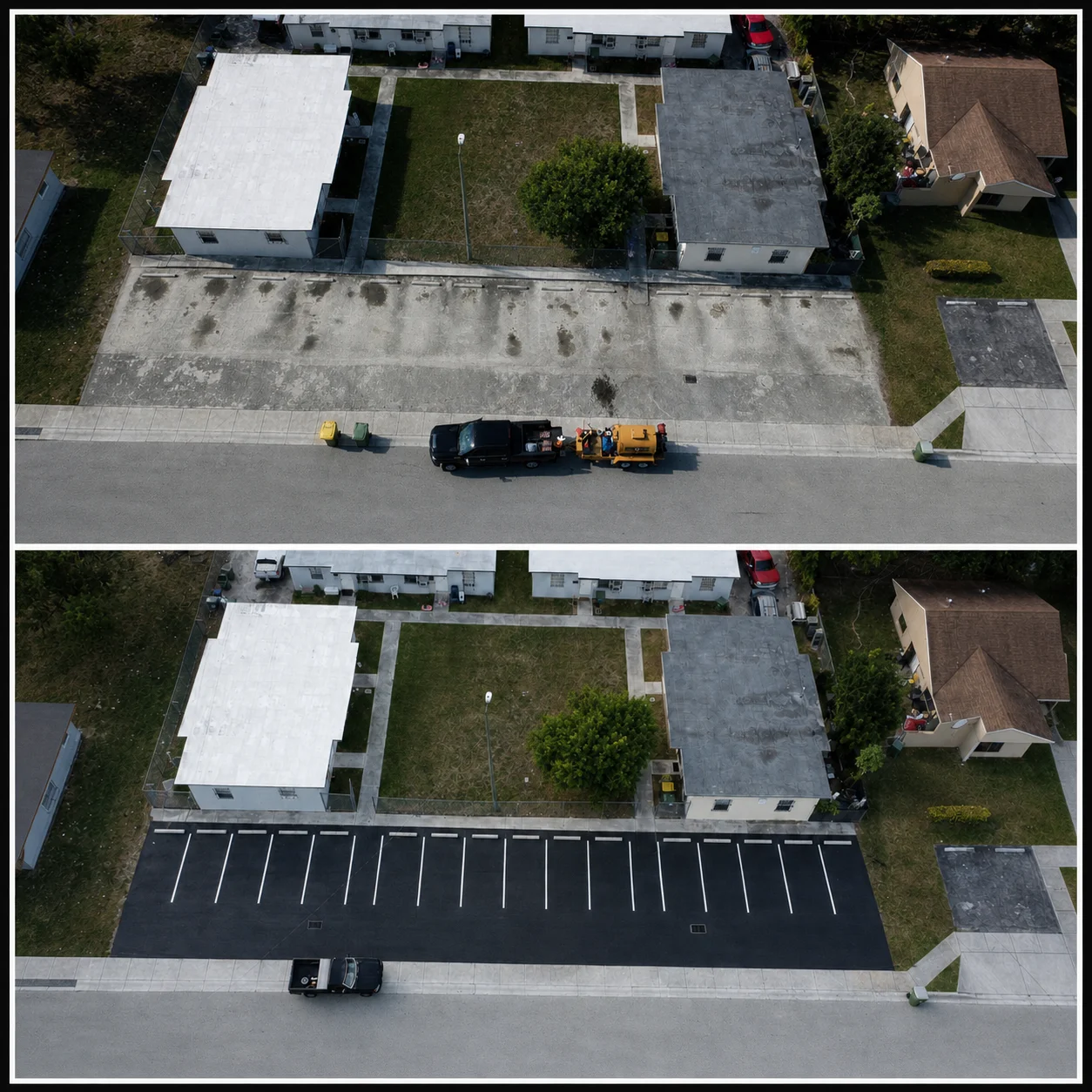
Before and after: faded stall lines restored on an apartment complex lot in Cutler Bay
Layout and Code: What Is Fixed and What Is a Local Call
Some parts of a lot layout are set by federal and state accessibility rules. Others are set by your local zoning and site plan, and the right answer is whatever your approved plan or the authority having jurisdiction says. This is general information, not legal advice, so work from your approved plan or the authority having jurisdiction.
| Item | What to know | Who decides |
|---|---|---|
| Standard stall | Commonly about 9 ft wide by 18 ft long, with compact stalls smaller. Exact minimums and compact-stall limits vary. | Local zoning code and your approved site plan |
| Accessible car space | At least 96 in wide with a 60 in access aisle (2010 ADA Standards, section 502). | ADA Standards and the Florida Accessibility Code |
| Van-accessible space | Either 132 in wide with a 60 in aisle, or 96 in wide with a 96 in aisle. At least 98 in vertical clearance. | ADA Standards and the Florida Accessibility Code |
| Accessible space marking | Florida law calls for accessible spaces to be outlined in blue paint and kept repainted so they stay clearly distinguishable, and for access aisles to be marked so people do not park in them. | Florida Statutes s. 553.5041 |
| Fire lanes | Marking, wording, and sign requirements come from the Florida Fire Prevention Code as applied by the local fire marshal. Colors and details differ by jurisdiction. | Local fire authority |
| Drive-aisle width | Depends on stall angle and whether the aisle is one-way or two-way. | Local code and site plan |
If your lot has accessible parking, it should be marked to the standards above; the stall, access aisle, symbol, and sign all need to agree with each other. For fire lanes, see our page on fire lane painting, and confirm the exact marking your local fire marshal wants before any paint goes down.
Timing Striping With Sealcoating, Repaving, and Florida Weather
Order matters. Paint goes on after repairs and after sealcoating, never before. Industry guidance says to let fresh sealer cure about 24 hours before striping, and to leave brand-new asphalt to cure for several weeks before painting it. Traffic paint also needs the pavement and air to be at least 50 degrees Fahrenheit, which is rarely a problem here.
Rain is the real scheduling issue. South Florida's rainy season generally runs from mid-May through mid-October, with near-daily afternoon storms, according to the National Weather Service in Miami. Striping needs a dry surface, so work is typically planned around the forecast, often starting early in the day. If you can pick your window, the drier months are easier to schedule.
Doing it all in one visit is a good way to limit disruption. A lot that needs commercial sealcoating can be sealcoated and striped in the same visit, so tenants, residents, and customers lose parking once instead of twice. If the pavement is past sealcoating, see asphalt overlay and resurfacing.
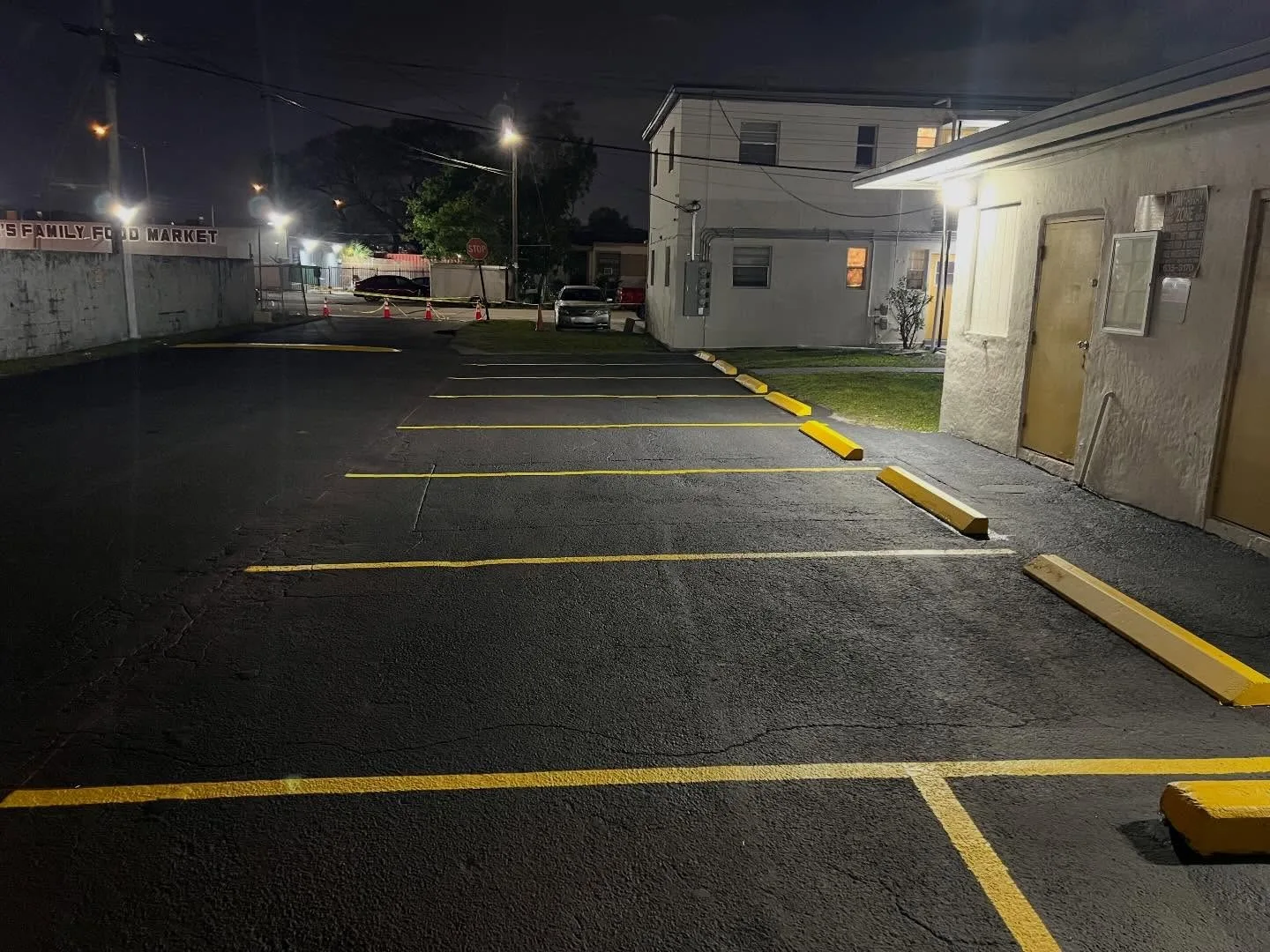
Fresh yellow stall lines and painted wheel stops on a residential property lot
How to Compare Striping Quotes
Striping prices are driven by the number of stalls, the total linear feet of line, the amount of special markings (accessible symbols, arrows, numbers, fire lane lettering), the condition of the pavement, whether old lines have to be removed or a layout changed, and how many mobilizations are involved (nights, weekends, phases). Because of that, two quotes only compare if they cover the same scope. Bull's Eye's price comes from the free on-site estimate, not from a generic per-stall formula.
Questions worth putting to any contractor:
- Is the quote based on a walk of the lot, or a satellite photo?
- Does it include accessible stalls, access aisles, arrows, numbers, and fire lane lettering, or only stall lines?
- What is included for cleaning and prep, and what happens if the lot needs crack filling first?
- How will the lot be closed, in what sections, and for how long?
- Can you provide a certificate of general liability insurance? (Bull's Eye carries general liability insurance, with proof available on request.)
- If the layout needs to change, who decides, and how is it approved?
Common Striping Mistakes to Avoid
- Painting over a bad layout. If stalls are too narrow or accessible spaces have drifted, new paint just locks the problem in for another cycle.
- Striping before repairs or sealcoating. Cracks reopen through paint, and sealer applied afterward can cover or smear fresh lines.
- Skipping the surface prep. Paint on dirt or oil flakes early.
- Letting traffic back too early. Tire marks and tracked paint make a new job look old on day one; proper coning and sectioning help avoid it.
- Treating accessible markings as an afterthought. Stall, aisle, symbol, and sign need to match, and a patchwork of old and new markings invites complaints.
- Not telling residents or tenants. Most complaints about a striping job are really complaints about surprise. A short notice with the dates and sections is usually all it takes.
Built for Property Managers and HOA Boards
If you answer to a board, an owner, or a tenant base, you need more than a clean lot: you need a plan you can explain. Bull's Eye works with HOA boards and property managers and offers phased, overnight, and weekend scheduling for commercial and HOA work, which helps tenants and residents keep parking access. One of our Google reviewers, from a multi-family property, put it this way: Bull's Eye "worked with our staff and tenants and made the sealcoating and striping job very easy."
Striping is also the natural finishing step for related work: curb painting for no-parking and loading zones, wheel stop installation in front of landscaping, walls, and walkways, and parking lot signs. Bundling related work reduces how often the property closes. Our FAQ covers scheduling and general questions as well.
Get a Free On-Site Estimate
Call (305) 710-4512 or request your free, no-obligation estimate online. We are open Monday to Friday 7 to 5 and Saturday 8 to 12. Let us know roughly how many stalls the lot has, whether it also needs sealcoating or repairs, and when you would like the work done, and the estimate will cover the rest on site.
Serving Cutler Bay and Nearby Communities
We're based in Cutler Bay and offer parking lot striping throughout the area. We also serve nearby Palmetto Bay, South Miami Heights, Goulds, Naranja, Princeton, Perrine and West Perrine, Richmond Heights and Richmond West. Not sure if your property is in our service area? Just give us a call.


