

Painted curbs tell drivers where they cannot stop, where they can load, and where emergency vehicles need room. Bull's Eye offers curb painting for HOAs, property managers, shopping centers, and warehouses in Cutler Bay and south Miami-Dade. Call (305) 710-4512 for a free, no-obligation on-site estimate.
What's Included
- No-parking and fire lane curb marking, matched to your fire marshal's requirements
- Loading zones, directional and safety curb markings
- Guidance on surface prep, since paint on dirty concrete fails early
- Durable traffic paint
- Can be planned with striping, wheel stops, and sign installation
Which Color Goes Where? It Depends on Who Enforces It
Curb color feels like it should be universal. It is not. The federal Manual on Uniform Traffic Control Devices allows curb markings in yellow, white, red, blue, or purple, and says local agencies may prescribe their own colors; it also recommends backing curb colors with standard signs so the rule is stated in words, not only in paint. On private property, the real answer comes from three places: your fire marshal (for fire lanes), your local code and permits, and your own parking rules.
| Marking | What is typical | Check with |
|---|---|---|
| Fire lane | The Florida Fire Prevention Code lets the local authority require approved signs and surface markings on fire lanes. Some Florida jurisdictions specify yellow curbs with "NO PARKING FIRE LANE" lettering; others use red. Signs commonly read NO PARKING FIRE LANE in red on white. | Local fire marshal |
| Loading or no-parking zone | Often yellow or red, backed by a sign. Meaning is set locally and by your own property rules. | Your local code, lease, or HOA rules |
| Accessible parking | Florida law requires accessible spaces to be outlined in blue paint. Signs and access aisle markings go with it. | Florida Statutes s. 553.5041 |
| Curb delineation | Yellow or white is commonly used to make curb edges and islands visible, especially at night. | Property plan, insurer, or traffic engineer |
The practical rule: confirm the color and wording with whoever will inspect the property before any paint goes down. For fire lanes in particular, see our page on fire lane painting, and for the blue accessible markings that sit beside them see ADA handicap striping and signage.
Why Curb Paint Fails Early, and What Prevents It
Curbs take more abuse than stall lines. They are vertical, so they get direct sun and splashed rain; they sit where tires rub, trucks swing wide, and mowers and landscapers bump; and they are often coated with oil, algae, and road film. Most curb paint failures are prep failures, not paint failures. A proper curb job includes the following.
- Sweep and clean. Dust, sand, and loose debris come off first.
- Degrease. Oil and grime buildup stops paint from bonding and is the usual reason new paint peels in sheets.
- Roughen the surface. Smooth concrete needs some surface texture for paint to grip, which is why painting over dirty or glossy concrete fails early.
- Use exterior-grade traffic paint. It should be applied evenly on the top and face of the curb as specified, with clean edges against the pavement and sidewalk.
- Protect it while it dries. Good practice is to schedule around dry weather and keep traffic off fresh paint until it is ready.
Florida Weather and Curb Paint
Paint needs a clean, dry surface. South Florida's rainy season generally runs from mid-May through mid-October, with near-daily afternoon thunderstorms according to the National Weather Service in Miami, so curb work is often planned for dry mornings and watched closely against the forecast. Traffic paint also needs pavement and air temperatures of at least 50 degrees Fahrenheit, which is rarely a concern here. Constant UV is the bigger long-term issue: expect curbs in full sun to fade faster than shaded ones.
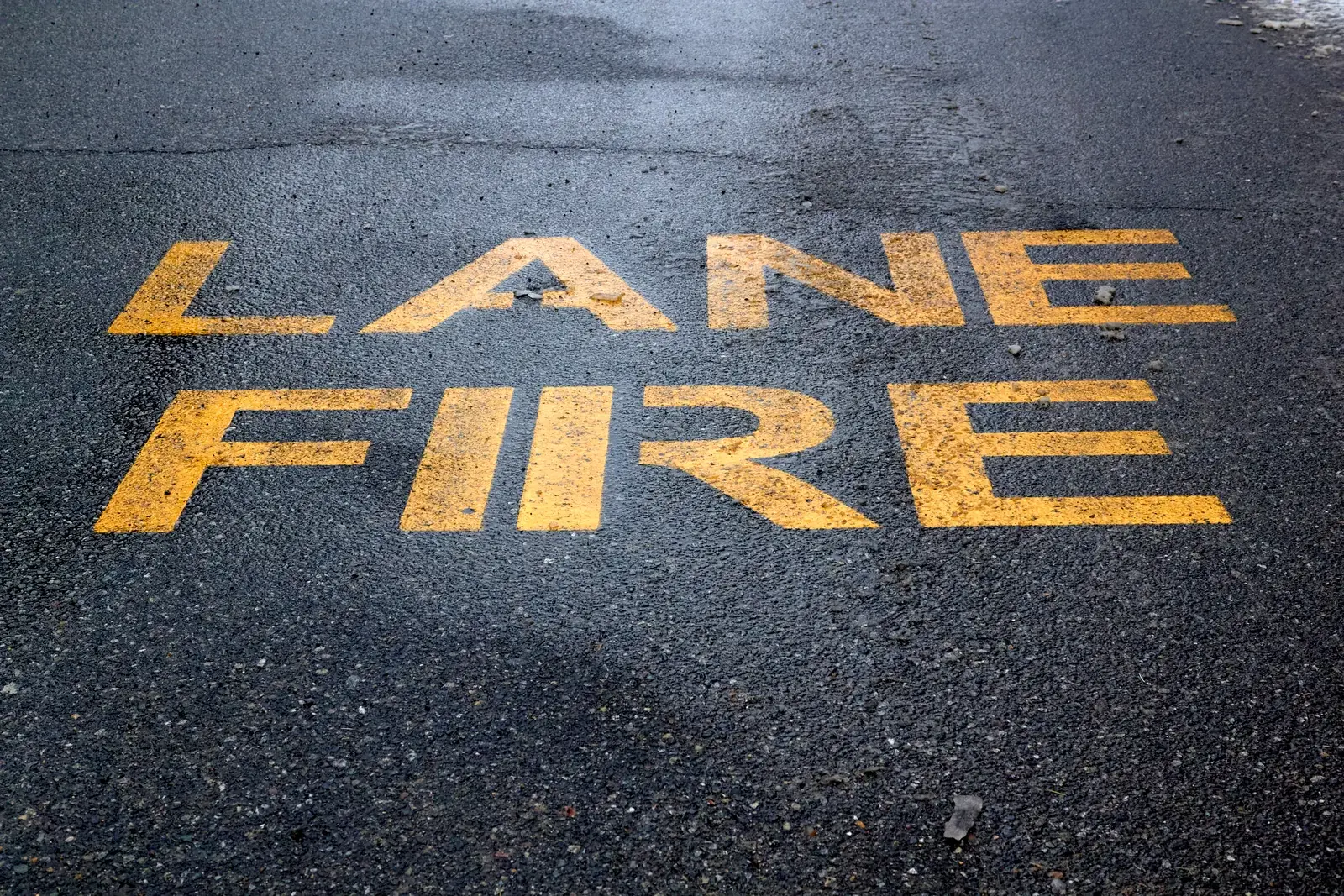
Fire lane lettering and curb markings are often painted together
Keeping Curbs Readable: Planning and Budget
Curb painting covers far less surface than a full restripe, so it is often the lowest-cost way to refresh safety markings between full striping cycles. The price still depends on linear feet of curb, how many colors and legends are involved, how dirty or previously painted the curbs are, and whether the work is bundled with other jobs. Bull's Eye's number comes from the free on-site estimate.
Plan to repaint curbs at least as often as you restripe, and sooner for fire lanes and accessible zones, where faded markings cause the most trouble. Tying curb painting to parking lot striping means a single visit and a single closure. If sealcoating is also due, sequence the work so curbs are not painted before the pavement beside them is finished. Bull's Eye can sealcoat and stripe in the same visit for a lot that needs commercial sealcoating, so ask about planning curb work around it.
Questions Property Managers Ask Before Hiring
- Who decides the color and wording? Your fire marshal or local code official for fire lanes; you or your board for loading zones and delineation. Get it in writing and share it with your contractor.
- Is a sign also required? Often yes. Fire lane rules commonly call for posted signs as well as paint, and the MUTCD recommends signs for parking regulations. See parking lot sign installation.
- What happens to old paint? Flaking or heavily built-up paint needs to be dealt with during prep, and it is worth pointing out during the estimate.
- Will it close driveways or entrances? Work can be sectioned so access stays open wherever possible. Bull's Eye offers phased, overnight, and weekend scheduling for commercial and HOA work.
- Do you carry insurance? Yes, general liability, with proof available on request.
Get a Free On-Site Estimate
Call (305) 710-4512 or request your free, no-obligation estimate online. Let us know roughly how much curb you have, what colors or wording your fire marshal or code requires, and whether the lot also needs striping, wheel stops, or signs. We are open Monday to Friday 7 to 5 and Saturday 8 to 12.
Serving Cutler Bay and Nearby Communities
We're based in Cutler Bay and offer curb painting for HOAs and commercial properties throughout the area, including alongside a full striping job. We also serve nearby Palmetto Bay, South Miami Heights, Goulds, Naranja, Princeton, Perrine and West Perrine, Richmond Heights and Richmond West. Not sure if your property is in our service area? Just give us a call.


