

Wheel stops keep vehicles out of landscaping, walls, sidewalks, and building fronts, but only if they are the right type, placed in the right spot, and anchored so they do not move. Bull's Eye offers wheel stop installation for HOAs, property managers, shopping centers, and garages in Cutler Bay and south Miami-Dade. Call (305) 710-4512 for a free, no-obligation on-site estimate.
What's Included
- Concrete or rubber wheel stops, chosen to suit the stall and the property
- Anchoring suited to the surface, so stops stay put under normal vehicle contact
- Placement that keeps accessible routes and access aisles clear
- Replacement of shifted, cracked, or missing wheel stops
- Can be scheduled with striping and curb painting
Where Wheel Stops Actually Earn Their Keep
A wheel stop is a simple, inexpensive barrier, but where it goes decides whether it solves a problem. They matter most where the front of a stall meets something that gets damaged or something people walk on: landscaping and irrigation, a building wall or storefront, a sidewalk, a dumpster enclosure, a utility box, or a fence. They are also useful at the end of rows where cars can roll out into a drive aisle, and anywhere an inattentive driver has already left a mark.
- Stalls that face a wall, planter, or walkway.
- Rows where tires have worn through landscaping or pushed into sidewalks.
- Stalls beside electrical equipment, fire riser rooms, meters, or gas lines.
- Places where overhanging bumpers narrow a sidewalk or block an accessible route.
Not every stall needs one. Putting them everywhere adds cost and creates trip hazards, so they are best used where they do real work.
Concrete or Rubber? Choosing the Right Material
| Type | Strengths | Watch for |
|---|---|---|
| Concrete | Heavy and durable, the traditional choice for commercial lots with heavy traffic. Typically lasts many years. | Can chip, spall, or crack over time, and can be a trip hazard if it blends into the pavement. Painting them a bright color helps. |
| Rubber | Lighter, flexes on impact instead of cracking, and sits close to the pavement. Often easier to place and replace. | Needs the right fasteners for the surface, and quality varies by product. |
| Recycled plastic | Lightweight and low-cost. | Industry sources note plastic can warp in extreme heat, which is worth considering in south Florida. Weigh this before choosing it. |
There is no single best answer. High-traffic commercial lots, loading areas, and garages often favor concrete or heavy rubber; light-use stalls and temporary needs can use lighter options. Concrete and rubber are the two most common choices for commercial lots, and the right one depends on traffic, surface, and budget.
Installation: What Keeps Wheel Stops From Walking Away
- Mark placement. A wheel stop is typically positioned from the stall layout, set back a couple of feet from the front of the stall and centered on the stall width, so it stops the tire without sticking out into the aisle behind it.
- Check clearance. The stop must not block an accessible route, an access aisle, or a walkway. The ADA Standards require that parked vehicles not obstruct the clear width of adjacent accessible routes (section 502.7), so stops should be placed accordingly.
- Anchor it. A proper installation fastens the stop to the pavement below with fasteners suited to the surface (asphalt or concrete) and the stop material, so it stays put under normal vehicle contact instead of sliding out of position.
- Make it visible. Wheel stops that blend into the pavement are a known trip hazard. Choose a visible color, and coordinate with your parking lot striping so lines, stops, and arrows all agree.
- Clean up. Debris and removed pieces should be cleared so the stalls are ready to use.
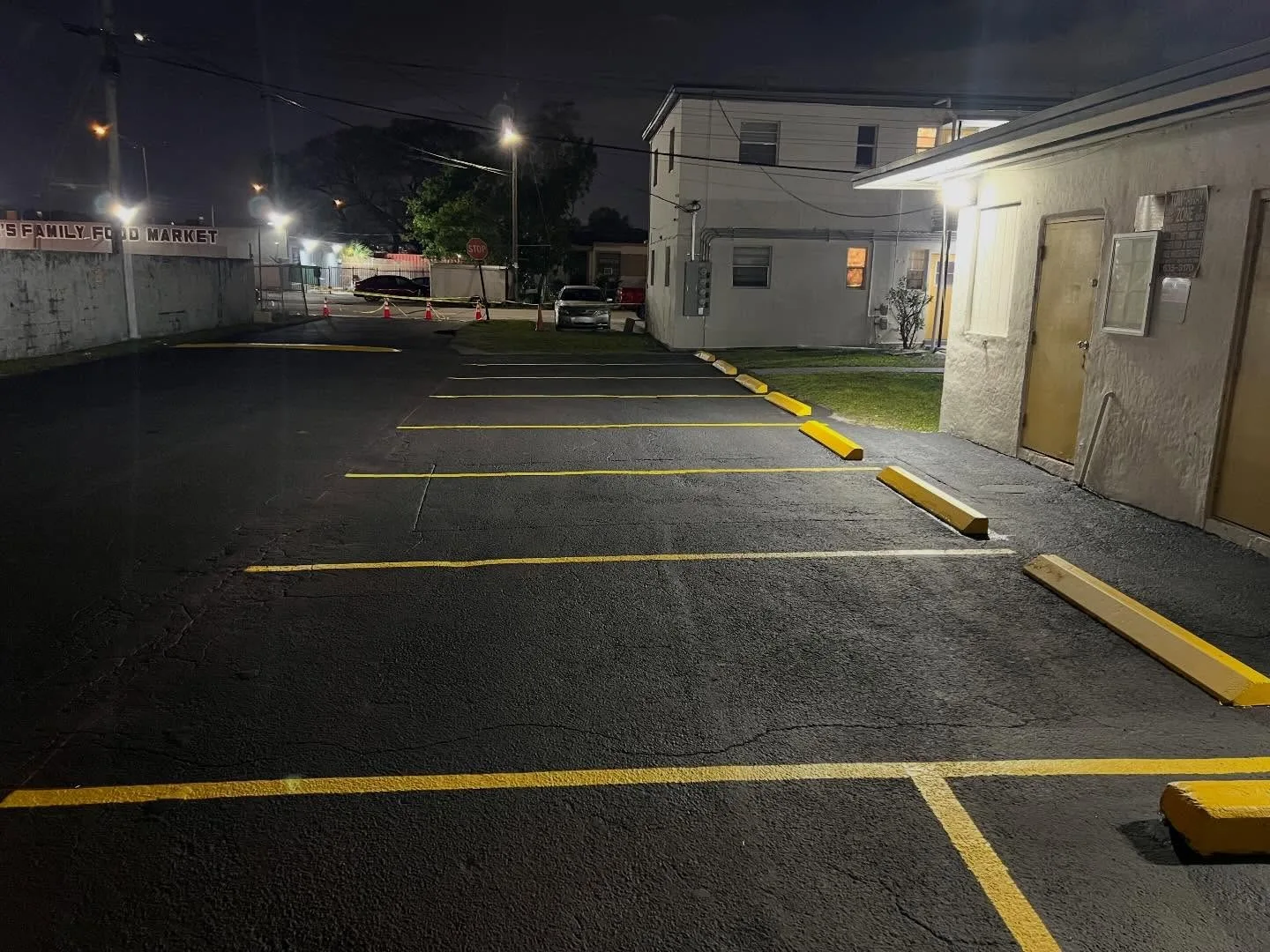
Yellow wheel stops in front of new stall lines, a visible color that reduces trip risk
Accessible Stalls and Wheel Stops
Wheel stops and accessible parking interact in a way that is easy to get wrong. The access aisle beside an accessible space must stay clear, and a stop placed in or across that aisle defeats its purpose. The ADA Standards also call for car and van spaces and access aisles of set widths (a 60 inch aisle for a car space; either a 96 inch space with a 96 inch aisle or a 132 inch space with a 60 inch aisle for van spaces). Check your plan, and for stall and marking details see our page on ADA handicap striping and signage. Where a stop is needed at an accessible stall, it should be placed to leave the aisle and access route clear.
When Existing Wheel Stops Need Replacing
- They have shifted, rotated, or been pushed out of line by repeated impact.
- Concrete has cracked, chipped, or exposed rebar edges.
- The fasteners have worked loose or pulled up from the pavement.
- They were set in the wrong place and cars are still hitting the wall or walkway behind them.
- After repaving, sealcoating, or restriping changes the layout, previously placed stops no longer match the stalls.
That last point is a good reason to coordinate. Wheel stops are best installed or reset along with pavement work and striping. If your lot is due for commercial sealcoating, Bull's Eye can sealcoat and stripe in the same visit, and wheel stops and curb painting are worth planning alongside so the property closes as few times as possible.
Cost and Scheduling
Price depends on how many wheel stops you need, the material, whether old ones are being replaced, the surface they anchor into (asphalt or concrete), and whether the work is bundled with striping or paving. Bull's Eye's price comes from the free on-site estimate. Bull's Eye offers phased, overnight, and weekend scheduling for commercial and HOA work, which helps tenants and customers keep their parking.
Get a Free On-Site Estimate
Call (305) 710-4512 or request your free, no-obligation estimate online. Let us know how many stalls are involved, whether stops are new or replacements, and what you want to protect. We are open Monday to Friday 7 to 5 and Saturday 8 to 12.
Serving Cutler Bay and Nearby Communities
We're based in Cutler Bay and offer wheel stop installation for HOAs and commercial properties throughout the area, including alongside a full striping job. We also serve nearby Palmetto Bay, South Miami Heights, Goulds, Naranja, Princeton, Perrine and West Perrine, Richmond Heights and Richmond West. Not sure if your property is in our service area? Just give us a call.


