

Accessible parking in Florida is governed by the federal 2010 ADA Standards and by the Florida Accessibility Code, and where the two differ, Florida's numbers are usually the larger ones: a 12-foot-wide space with a 5-foot striped access aisle, a blue outline, and a permanent sign at least 60 inches off the ground. Below is how the rules fit together, how many spaces your lot needs, and what a correct restripe looks like, so you can check your lot before you call. When you want it laid out, striped, and signed, Bull's Eye provides ADA-compliant striping and signage in Cutler Bay and the surrounding area.
What's Included
- Accessible stalls striped to your lot's required count, with striped access aisles
- Blue stall outlines and painted accessible symbols
- Van-accessible stall layout when your count requires it
- Permanent accessible parking signs installed alongside the striping
- Correction of existing stalls only, or full restripe of the lot, in one visit
Which Rules Actually Apply to a Cutler Bay Parking Lot
Three layers apply, and the practical answer is to build to whichever is strictest. The 2010 ADA Standards for Accessible Design (sections 208 and 502 cover parking) are the federal rules for businesses open to the public. The Florida Building Code, Accessibility (the Florida Accessibility Code) adds state requirements, and Florida Statute 553.5041 spells out the accessible parking details: width, access aisle, striping, and signs. Code editions are updated on a schedule, so confirm which edition applies to your project with your building department.
Accessible Stall Dimensions at a Glance
| Element | Requirement | Source |
|---|---|---|
| Accessible stall width (Florida) | At least 12 feet, marked to show the width | Florida Accessibility Code 502.2; Fla. Stat. 553.5041 |
| Access aisle | At least 60 inches (5 feet) wide, the full length of the stall, adjoining an accessible route | ADA 502.3 and Florida 502.3 |
| Access aisle marking | Striped diagonally to mark it as a no-parking zone | Florida 502.3.3 |
| Van stall (ADA options) | 132 inches wide with a 60-inch aisle, or 96 inches wide with a 96-inch aisle; 98 inches minimum vertical clearance | ADA 502.2, 502.3; 2010 ADA Standards |
| Slope and surface | No steeper than 1:48 in any direction; firm, stable, slip-resistant | ADA 502.4, 302.1 |
| Stall outline | Prominently outlined in blue paint, repainted when necessary | Fla. Stat. 553.5041; Florida 502.6.1 |
| Sign | Permanent, above grade, international symbol of accessibility, bottom of sign at least 60 inches above the ground; Florida wording "PARKING BY DISABLED PERMIT ONLY" and the penalty notice; van stalls signed "van accessible" | ADA 502.6; Florida 502.6, 502.6.1 |
One note on van stalls: the ADA allows either a wider van stall or a wider aisle. Florida also sets a 12-foot minimum stall width, so the exact van layout for your property is something to confirm with your building department or design professional before painting.
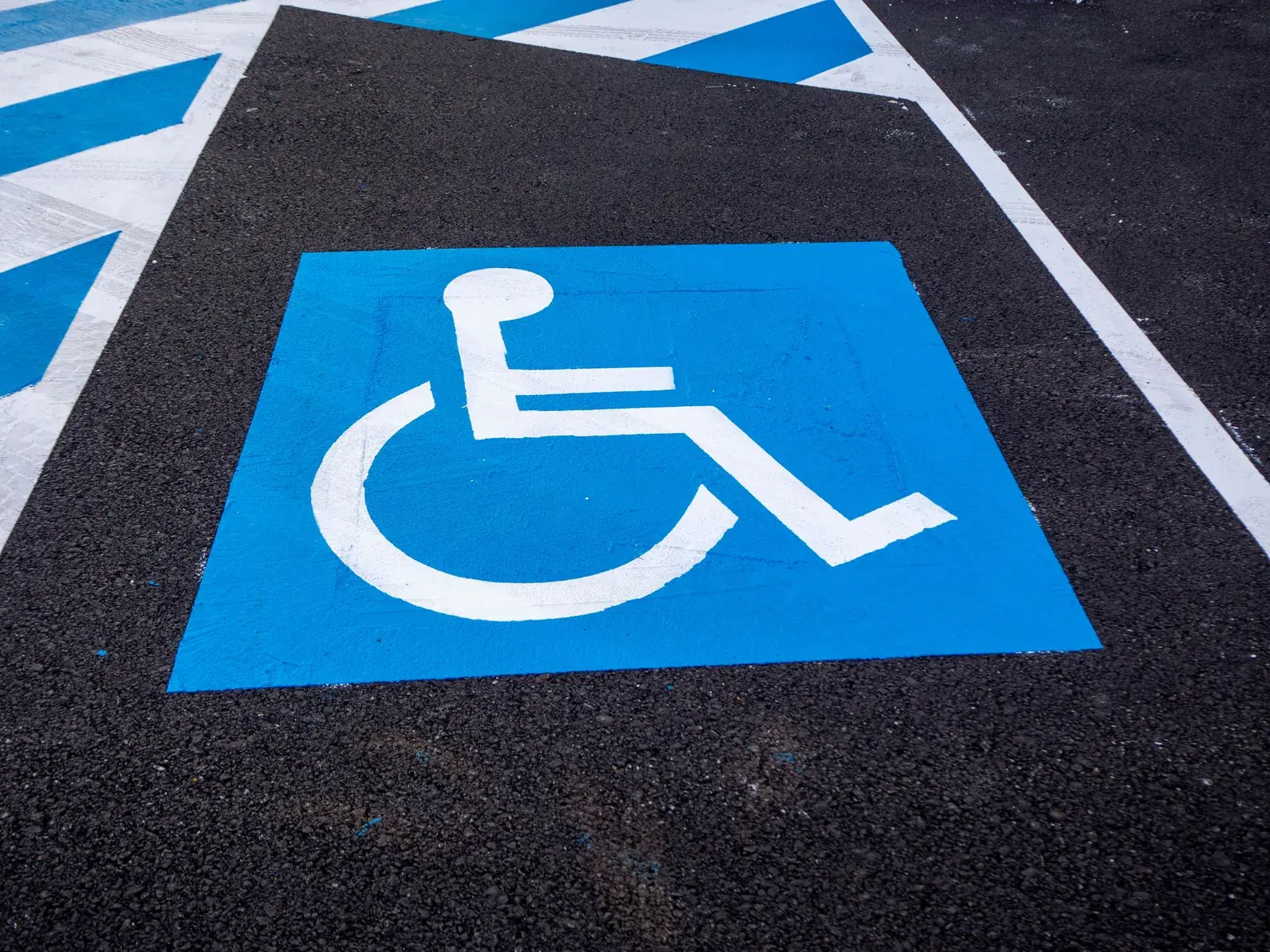
A painted accessible symbol beside a striped access aisle. The sign on a post, not the paint, is what the standards require for identification.
How Many Accessible Spaces Does Your Lot Need?
The count depends on the total number of spaces in each parking facility on the site. This is Table 208.2 of the 2010 ADA Standards, and it is the number most people searching for ADA parking lot requirements need first.
| Total spaces in lot | Minimum accessible spaces | Of those, van accessible |
|---|---|---|
| 1 to 25 | 1 | 1 |
| 26 to 50 | 2 | 1 |
| 51 to 75 | 3 | 1 |
| 76 to 100 | 4 | 1 |
| 101 to 150 | 5 | 1 |
| 151 to 200 | 6 | 1 |
| 201 to 300 | 7 | 2 |
| 301 to 400 | 8 | 2 |
| 401 to 500 | 9 | 2 |
| 501 to 1,000 | 2% of total | 1 in 6 of the accessible spaces |
| 1,001 and over | 20, plus 1 for each 100 over 1,000 | 1 in 6 of the accessible spaces |
The van rule is one van-accessible space for every six accessible spaces or fraction of six, and never fewer than one. Spaces must sit on the shortest accessible route to an accessible entrance, and where a site has several lots or garages, the spaces are scaled to each facility rather than pooled in one place. Count the stalls you actually have, not the stalls the original plan showed.
Striping Details That Get Missed
- The access aisle is not a parking space. It must be striped (diagonal hatching) so no one parks in it. Florida treats the access aisle as part of the accessible space, so it must stay clear of parked cars.
- Blue outline. Florida requires the accessible stall to be prominently outlined in blue and repainted when it fades. Painted symbols are customary, but do not skip the sign, which is what the standards require for identification.
- Level ground. A stall or aisle steeper than 1:48 (about 2 percent) fails regardless of how good the paint looks. Settlement, patches, and cross-slope near drains can push a stall out of tolerance.
- Wheel stops and the route. A wheel stop or a car overhanging the aisle can shrink the clear width of the accessible route. Placement of wheel stops in front of accessible stalls deserves a second look.
- Curb ramps. A curb ramp or its flared sides must not project into the stall or aisle (Florida 406.5), so ramp location and the stripe layout have to be planned together.
Accessible Parking Signs
Each accessible space needs a permanent sign on a post or wall, not just paint on the ground. Under the ADA Standards the sign carries the International Symbol of Accessibility and sits with its bottom edge at least 60 inches above the pavement. Florida adds the caption "PARKING BY DISABLED PERMIT ONLY," a sign design approved by the Department of Transportation, and a statement of the penalty for illegal use; van spaces are identified as "van accessible." Bull's Eye offers these through its parking lot sign installation service so the striping and the signs can match.
Restriping an Existing Lot: What the ADA Says
Federal guidance is direct on two points. First, when a business restripes a lot, it must provide the accessible spaces the standards require. Second, a business that serves the public has a continuing obligation to remove barriers in an existing lot when doing so is readily achievable, and because restriping is relatively inexpensive, it usually is. The Access Board also notes that normal maintenance such as pothole repair, surface patching, or repainting existing striping in place for a few spaces is not by itself an alteration, unless it affects the facility's usability. In plain terms: a simple refresh of correct stalls is maintenance, but a layout change or a full re-layout is the moment to get the accessible count, widths, aisles, and signs right.
Who Is Affected: Businesses, Shopping Centers, HOAs, and Apartments
Businesses open to the public, such as shopping centers, offices, restaurants, medical buildings, and similar properties, are the clearest cases. For residential communities, the answer depends on the facility. Residential-only common areas are generally treated differently than public accommodations, and other rules such as the Fair Housing Act or the Florida Building Code may apply. This page is not legal advice, so if your HOA or condominium board is unsure what applies to its lots, ask your association attorney or your building department before ordering work.
Why Non-Compliance Is Worth Fixing
Accessible parking is one of the easiest barriers for a complainant to document with a tape measure, and a lot that fails can lead to complaints, demand letters, or enforcement action. Penalty amounts change over time, so ask your attorney what applies to your property. Correcting a few stalls and signs is usually far less costly than dealing with a complaint, and a free on-site estimate from Bull's Eye tells you what that correction would cost for your lot.
What a Proper ADA Striping Job Looks Like
- Count and measure. The lot is walked, total stalls are counted, the locations of accessible spaces are identified, and widths and aisles are checked against the table above.
- Check slope, surface, and route. Stalls on a visible slope, a damaged surface, a missing curb ramp, or an overhanging wheel stop get flagged. If the pavement itself needs patching or crack sealing first, that should be dealt with before painting over a problem.
- Lay out and mark. Stall outlines, access aisles, and symbols should be marked out before any paint goes down.
- Stripe and sign. Blue outlines, hatched aisles, and symbols are painted, and signs are set on posts at the required height.
- Walk it with the owner. A final walk-through covers what was done and what, if anything, is left for another trade or your engineer.
Common Mistakes on Faded Lots
- Restriping the old, narrow stalls exactly as they were instead of correcting them.
- Paint without a post-mounted sign, or a sign mounted too low.
- No access aisle hatching, so the aisle is used as a regular space.
- Accessible stalls placed far from the entrance because that is where the spare stalls were.
- A fresh coat of blue over a stall that is too steep or too narrow, which looks right and still fails.
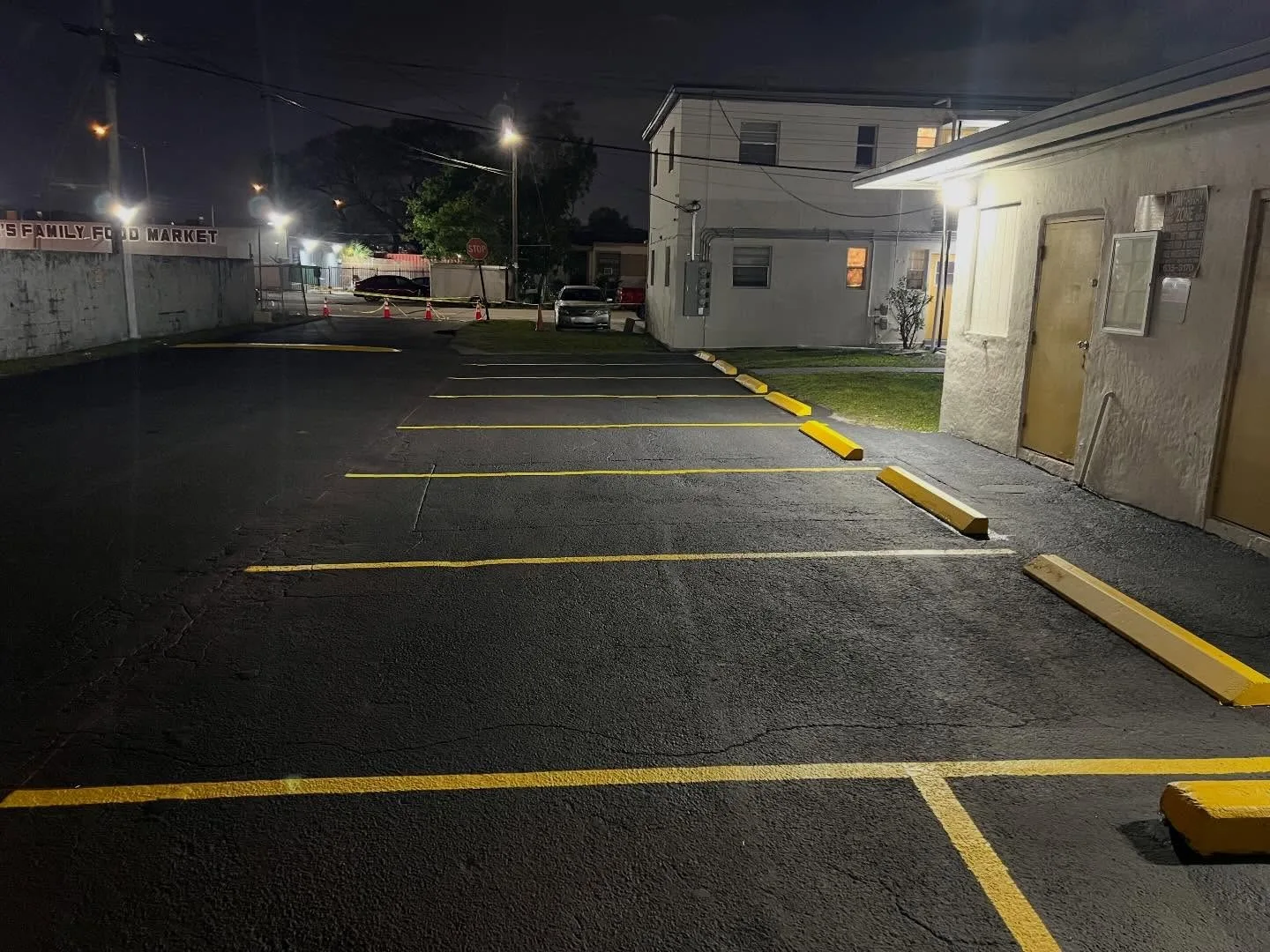
A freshly striped lot with wheel stops. Accessible stalls need the same layout care, plus the aisle and sign.
Confirm Local Requirements, Then Call
This page summarizes published standards; it is not legal advice, and the authority that matters is your local building department or the design professional of record for your site. Miami-Dade County and individual municipalities can add their own requirements, so confirm the details for your property. If you want a second set of eyes on your lot, request a free on-site estimate or call (305) 710-4512. Bull's Eye can sealcoat and stripe in the same visit, so pairing this work with full parking lot striping or sealcoating can limit closures. For more answers, see our FAQ.
Serving Cutler Bay and Nearby Communities
We're based in Cutler Bay and provide ADA-compliant striping and signage for HOAs, commercial properties, and businesses throughout the area, often alongside a full parking lot striping job. We also serve nearby Palmetto Bay, South Miami Heights, Goulds, Naranja, Princeton, Perrine and West Perrine, Richmond Heights and Richmond West. Not sure if your property is in our service area? Just give us a call.


