

Sealcoating cost depends mostly on square footage, how much crack and oil-spot work the pavement needs, how many coats are applied, and how hard the site is to work around. National guides give wide ranges, so the only number that matters is the one written for your pavement after someone measures it. This guide explains what moves the price, how a driveway quote differs from a commercial lot quote, and what to look for before you sign.
Typical Industry Ranges (Not a Quote)
Published sealcoating prices vary a lot, and much of the gap is what each source includes. The figures below are typical industry ranges compiled from manufacturer, contractor and consumer cost guides that we opened and checked in October 2026. They are not Bull's Eye prices and not a quote. We could not find a Miami-Dade-specific price study, so treat any single number as an estimate; the one Florida contractor guide we found (Tampa Bay) sits inside the national range.
| Job type | Typical industry range | Why the range is wide |
|---|---|---|
| Commercial parking lot, sealcoat only | Roughly $0.10 to $0.50 per square foot; most guides cluster around $0.15 to $0.35 | Large, simple lots sit at the low end; small lots, islands, curbs, phasing, sealer type and coat count push it up |
| Residential asphalt driveway, per square foot | Roughly $0.15 to $0.25 per square foot for the sealer work | Repairs, cleaning and the contractor's minimum are often outside this figure |
| Residential driveway, whole job | Roughly $150 to $800; typical national averages quoted run about $300 to $550 | Driveway size, prep, one coat or two, region |
| Hot-pour crack filling (separate line item) | Roughly $0.50 to $2.20 per linear foot; most guides say about $1 to $2 | Crack width, depth and how many cracks |
| Mobilization or small-job fee | Roughly $250 to $1,400 depending on the guide and lot size | Travel, setup and the contractor's own minimum |
Where the Sources Disagree, and Why
The published figures do not line up, and the gaps have identifiable causes.
- Commercial top end. One guide puts commercial sealcoating at $0.25 to $0.60 per square foot, while a sealer manufacturer says 10 to 30 cents and a Florida contractor says $0.15 to $0.30. Most pages in between land at $0.15 to $0.50. We therefore cap the range at about $0.50 and treat $0.60 as an outlier that likely folds in prep.
- Residential per-foot versus all-in. Consumer guides give about $0.15 to $0.23 per square foot for asphalt sealer, yet one widely quoted guide also cites $1.25 to $1.50 per square foot for materials and labor together. The all-in figure appears to bundle repairs and labor on small jobs and no other source we opened supported it, so we left it out. Whole-driveway averages ($305 in one guide, $545 in another) differ mainly because of how many repairs and coats are assumed.
- Coats. Residential guides often assume one coat; commercial guides usually assume two. A second coat can add cost, although one guide notes prep is done only once.
- Crack filling and prep. Some figures are sealer only; others bundle crack sealing and striping, which two contractor guides price at roughly $0.60 to $0.90 per square foot in total. Prep prices also vary widely: pressure washing is quoted at $0.05 to $0.10 per square foot in one guide and $0.27 to $0.39 in another, so we do not give a prep range.
- Size and region. Larger lots cost less per square foot, and most guides come from other regions (New Jersey, Michigan, Colorado, Texas). Local labor, wet-season scheduling and access can move a South Florida bid either way.
Residential Driveway vs Commercial Lot
A driveway is usually priced as one job with a minimum charge, while a commercial lot is priced by the square foot with line items for everything around the sealer.
- Driveway. The area is small, so fixed costs weigh more. Contractors often have a minimum charge, and cracks, oil stains and edging along the garage and walkways are a large share of the effort. See driveway sealcoating for how to tell whether a driveway needs it at all.
- Commercial or HOA lot. The area is large, so unit price falls, but islands, curbs, drive aisles and tenant access add handwork. Work often has to be staged in sections or done overnight or on weekends so the property stays usable. Phasing adds mobilization cost, one reason a lot may be quoted in sections. Bull's Eye schedules commercial and HOA work in phases, overnight or on weekends. See commercial parking lot sealcoating.
- Striping. On lots, restriping after sealcoating is usually its own line item, covered in the parking lot striping cost guide. Sealcoating and striping can be done in the same visit, which means one disruption for tenants.
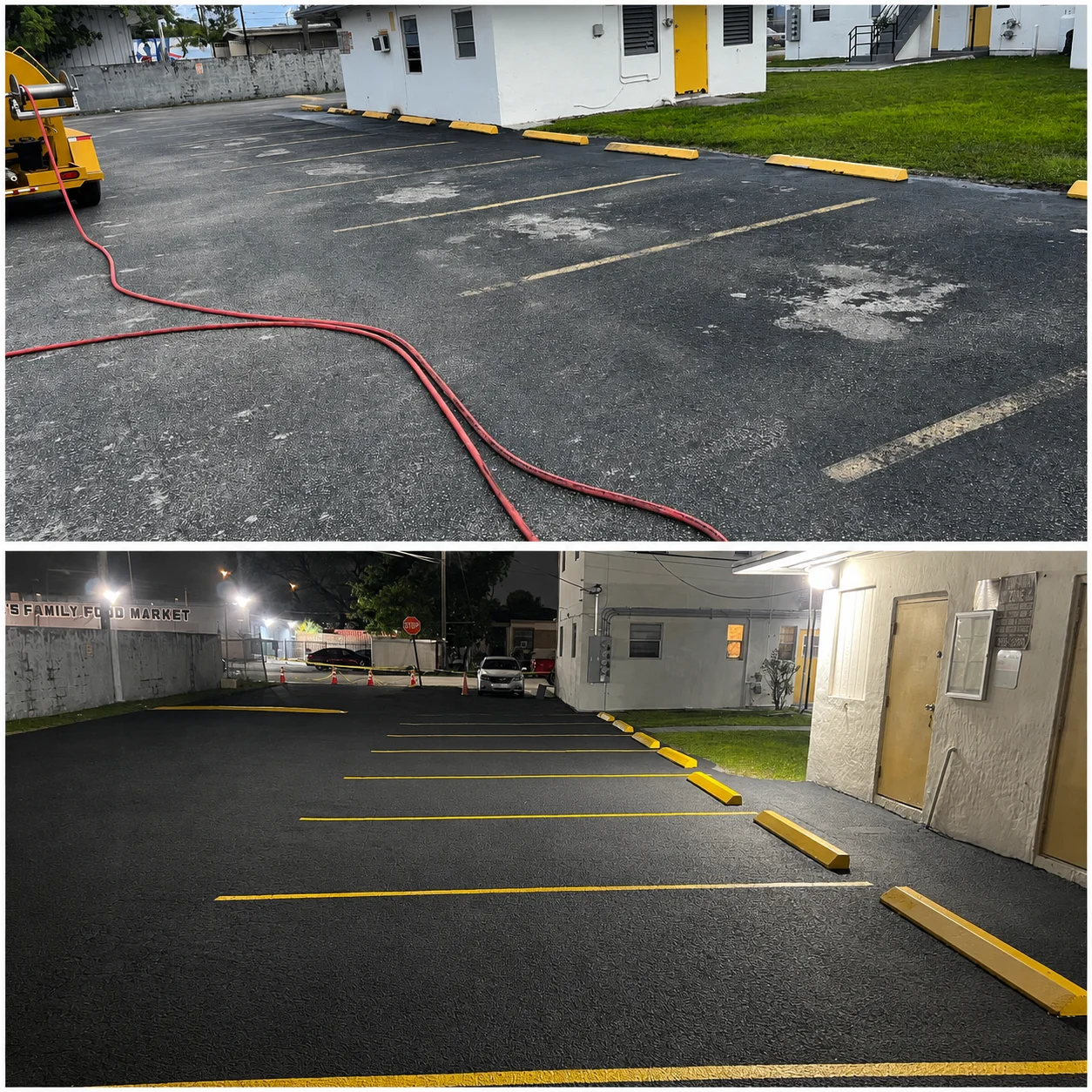
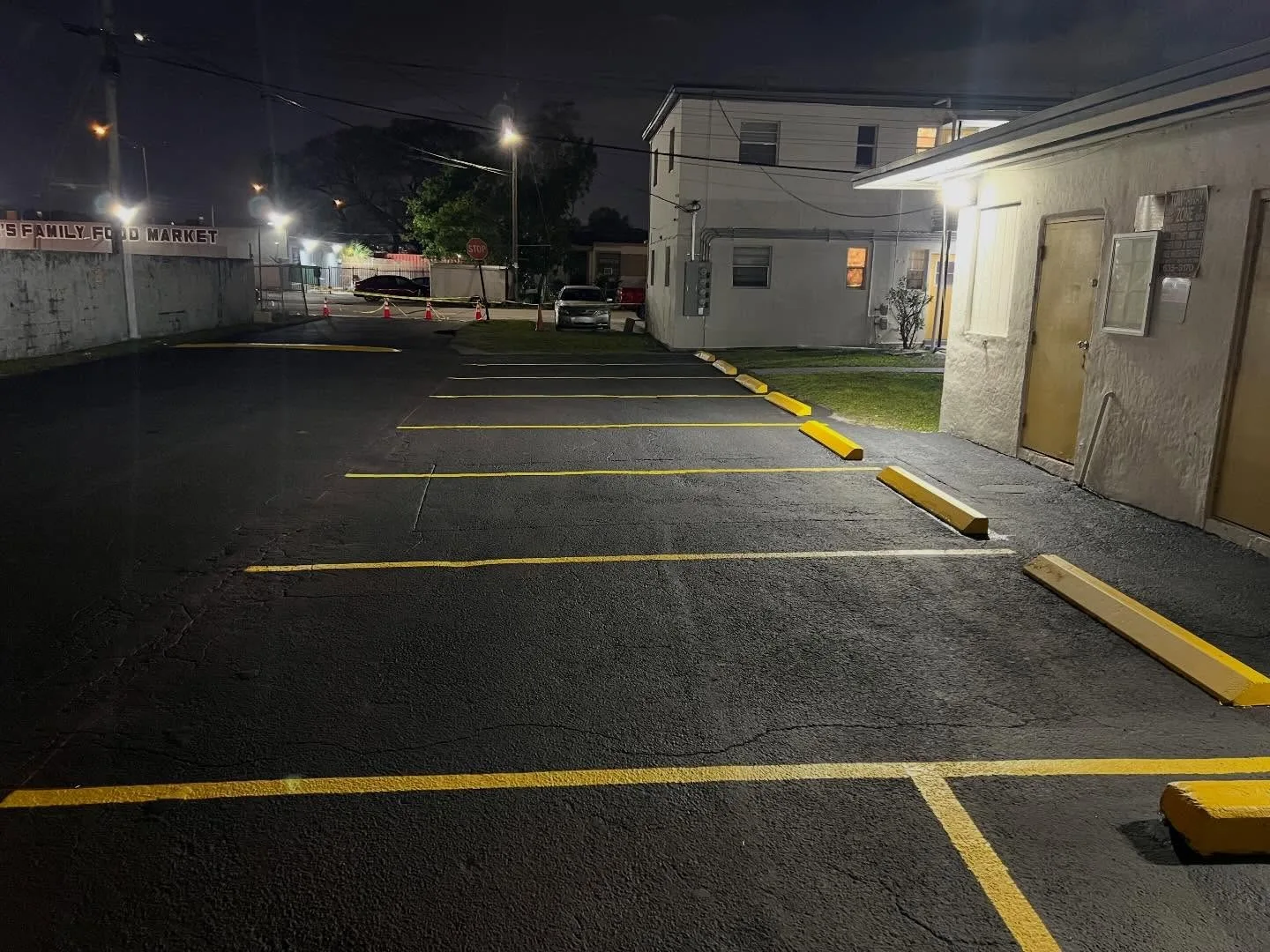
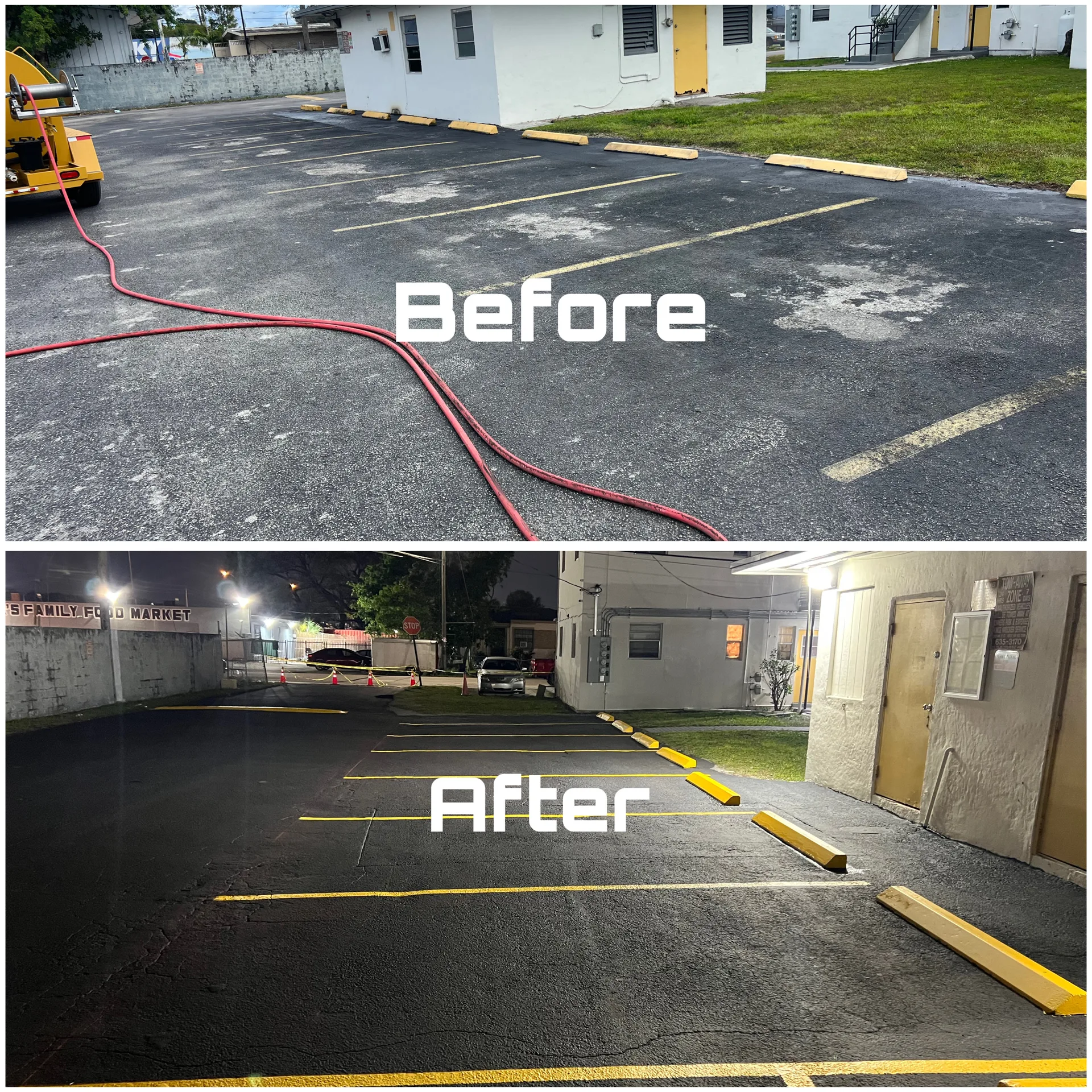
A commercial lot after sealcoating and striping.
What Drives Sealcoating Cost
- Total square footage. Material, labor and setup all scale with area. An accurate measurement matters, because an area error carries through the whole estimate.
- Condition of the pavement. Older, oxidized asphalt tends to absorb more sealer than newer pavement, and heavy cracking adds prep before any sealer goes down.
- Crack filling. Sealer does not bridge open cracks, so good practice is to fill them first, with hot-pour rubberized filler for most work. More cracks means a higher price, and it is the line item most often left out of cheap quotes. See crack filling and sealing.
- Oil and gas spots. Petroleum stains need cleaning and priming so sealer bonds. Parking stalls and loading areas usually have more of them than driveways.
- Number of coats. One coat costs less than two. Bull's Eye applies two coats, and a quote that is much lower than the rest often reflects a thinner scope.
- Layout and access. Curbs, islands, tight turns, landscaping, parked vehicles and gated entries all slow the work.
- Phasing and schedule. Work split into sections, or done overnight or on weekends, costs more to coordinate than one open-lot day.
- Weather windows. Sealer needs dry pavement. South Florida's wet summer months can make dry working days harder to find and can mean rescheduling.
- Add-on repairs. Patching, potholes, and striping are separate items. See pothole repair and patching.
How to Read a Quote
A useful quote lets you compare two bids line by line. If the scope is one vague sentence, you cannot tell why one bid is cheaper than another.
| Quote line | What to look for |
|---|---|
| Itemized scope | Cleaning, crack filling, oil-spot treatment, sealcoat, and any striping listed separately rather than as one lump sum |
| Square footage | A stated area, so you can divide price by area and compare bids on the same basis |
| Coats | The number of coats, ideally two, stated in writing |
| Crack filling | Whether it is included, what material is used, and whether it is priced by the foot |
| Oil-spot treatment | Whether stains are cleaned and primed before sealing |
| Striping and signs | Included or excluded, and whether the existing layout is repainted as is |
| Closure and cure time | How long the area stays closed before vehicles can return, and how the schedule is communicated to residents or tenants |
| Insurance | Proof of general liability coverage, available on request. Bull's Eye carries general liability insurance and provides proof on request. |
| Payment and schedule | When payment is due and what happens if weather moves the job |
If one bid is far below the others, ask what it leaves out before accepting it. A low price may reflect a single thin coat, skipped crack work, minimal cleaning, or thinned sealer. We did not find a reliable percentage threshold, so compare scope first.
Red Flags Homeowners and Managers Complain About
These are common pitfalls with any asphalt contractor, and each one can be checked before you hire.
- Pressure to decide on the spot. Unsolicited crews offering an immediate discount because they are “in the area” are a classic warning sign. A fair deal should still be there tomorrow, after you have checked who is offering it.
- Sealer thinned too far. Over-diluted sealer looks patchy and washes away. Ask what is mixed in and whether it follows the manufacturer's limits.
- Cracks left unfilled. Sealer is a coating, not a filler. Cracks that show through soon after sealing usually were not filled first.
- Sticky or tracked sealer. A coat applied too thick, or under poor drying conditions, can stay tacky. Ask how long the area stays closed.
- No written scope. A price with no square footage, coats or crack work cannot be compared or enforced.
- No proof of insurance. Property managers and HOA boards should ask for it before work starts.
- Vanishing after payment. Check that the business has a real address and phone number you can reach later. Bull's Eye is at 8260 SW 184th St in Cutler Bay and answers at (305) 710-4512.
When Sealcoating Is the Wrong Spend
The cheapest sealcoating is the one you do not need, and the most wasted money is sealer over pavement that is past saving. Sealcoating is maintenance for sound asphalt. Widespread alligator cracking, soft spots and potholes need patching, an overlay, or new paving. The sealcoating vs overlay vs repaving guide explains how to tell which one fits, and how often to sealcoat in Florida covers timing.
How to Get a Number You Can Trust
- Get at least two or three written quotes for the same scope and square footage.
- Ask each bidder the same questions: how many coats, how cracks are filled, how oil spots are handled, and how long the area stays closed.
- Compare price per square foot only after the scopes match.
- Check insurance and a real business address before work starts.
- Plan for weather. A good contractor will move a job rather than apply sealer ahead of a storm.
Serving Cutler Bay and Nearby Communities
Bull's Eye is based at 8260 SW 184th St in Cutler Bay and serves Palmetto Bay, South Miami Heights, Goulds, Naranja, Princeton, Perrine, West Perrine, Richmond Heights and Richmond West. Not sure if you are in range? Just call.
Get a Free On-Site Estimate
Call (305) 710-4512 or request your free on-site estimate. Hours are Monday to Friday 7 to 5 and Saturday 8 to 12. Estimates are free and come with no obligation. For quick answers, see the FAQ.