

Asphalt in South Florida usually fails for a handful of reasons that work together: sun that hardens the surface, heavy rain, a water table close to the surface, repeated traffic and poor drainage. Knowing which one is at work tells you whether you need crack filling, patching, sealcoating or resurfacing. This guide explains each cause using public research and ties it to the repair that fits.
The Short Answer
Asphalt fails when its two jobs, staying flexible on top and staying firm underneath, both break down. The sun stiffens the surface binder until it cracks, water gets through those cracks, the base underneath weakens, and traffic then breaks the surface above it. South Florida adds more rain, more sun and a high water table than most of the country, so the cycle can run quickly if cracks go untreated. The table below summarizes the causes and fixes; the sections after it explain each one.
| Cause | What it looks like | Repair that fits |
|---|---|---|
| Sun and heat (oxidation) | Gray, dry, rough surface; loose stone; fine cracks | Sealcoating while the pavement is still sound |
| Water entering cracks | Open cracks, then soft spots and potholes | Crack filling, then patching |
| Shallow water table and weak base | Repeat potholes, sinking areas | Patch properly; overlay or new paving if widespread |
| Traffic loading | Alligator cracking, ruts in wheel paths, shoving at turns | Patch failed areas; overlay or reconstruction if widespread |
| Poor drainage and ponding | Standing water, edge breakup, stains | Correct the grade or drainage, then repair |
| Tree roots | Humps and cracks near trees | Patch or overlay; root management is a separate decision |
| Worn markings and curbs | Faded lines, trip hazards | Restriping after repairs |
Sun and Heat: The Surface Gets Brittle
Sunlight and heat age the asphalt binder, the glue that holds stone together, and an aged binder is stiffer and more brittle. A study of asphalt aging published in the journal Materials, indexed by the U.S. National Library of Medicine, compared samples aged by UV exposure and heat against samples aged by heat alone. UV-aged samples stiffened more, and the aging was concentrated near the surface, with the difference between the top and middle layers much larger than in oven aging. In plain terms, the top of the pavement ages faster than what is below it, which matches what you see on an old lot: a gray, rough, raveling surface. The Federal Highway Administration defines raveling as the wearing away of the pavement surface caused by dislodging of aggregate particles.
The Asphalt Institute says a well-built low-traffic pavement, such as a parking lot or driveway, should not need sealing for roughly 2 to 5 years depending on climate and quality of the original work, and that sealing should be done as soon as dryness, brittleness, small cracks or surface voids appear. Sealcoating is the preventive answer to this cause; it slows surface aging but does not repair damage that has already reached the base. See our guide on how often to sealcoat in Florida.
Heat also softens asphalt. The FHWA's manual describes bleeding as a shiny film of binder on the surface that may be tacky in warm weather, and rutting as longitudinal depressions in the wheel paths. Both show up where heavy, slow or parked loads meet a hot surface.
Heavy Rain: Water Is the Real Destroyer
Rain does the damage by getting in. National Weather Service data for Miami show that the summer season, with a median start of May 21 and median end of October 17, produces about 69 percent of annual precipitation and brings frequent showers and thunderstorms almost daily. Each storm sends water to every open crack in a lot.
Federal pavement preservation guidance treats crack treatments as a way to keep water out of the lower layers, because water that enters weakens the base and leads to potholes. A National Academies guideline on moisture damage in pavements groups the control strategies as keeping moisture out, getting it out quickly, and using materials less sensitive to it, and warns that fixing the surface will not cure a problem whose main water source is elsewhere. For a parking lot owner, the practical lesson is to fill cracks early and to find where water sits and why.
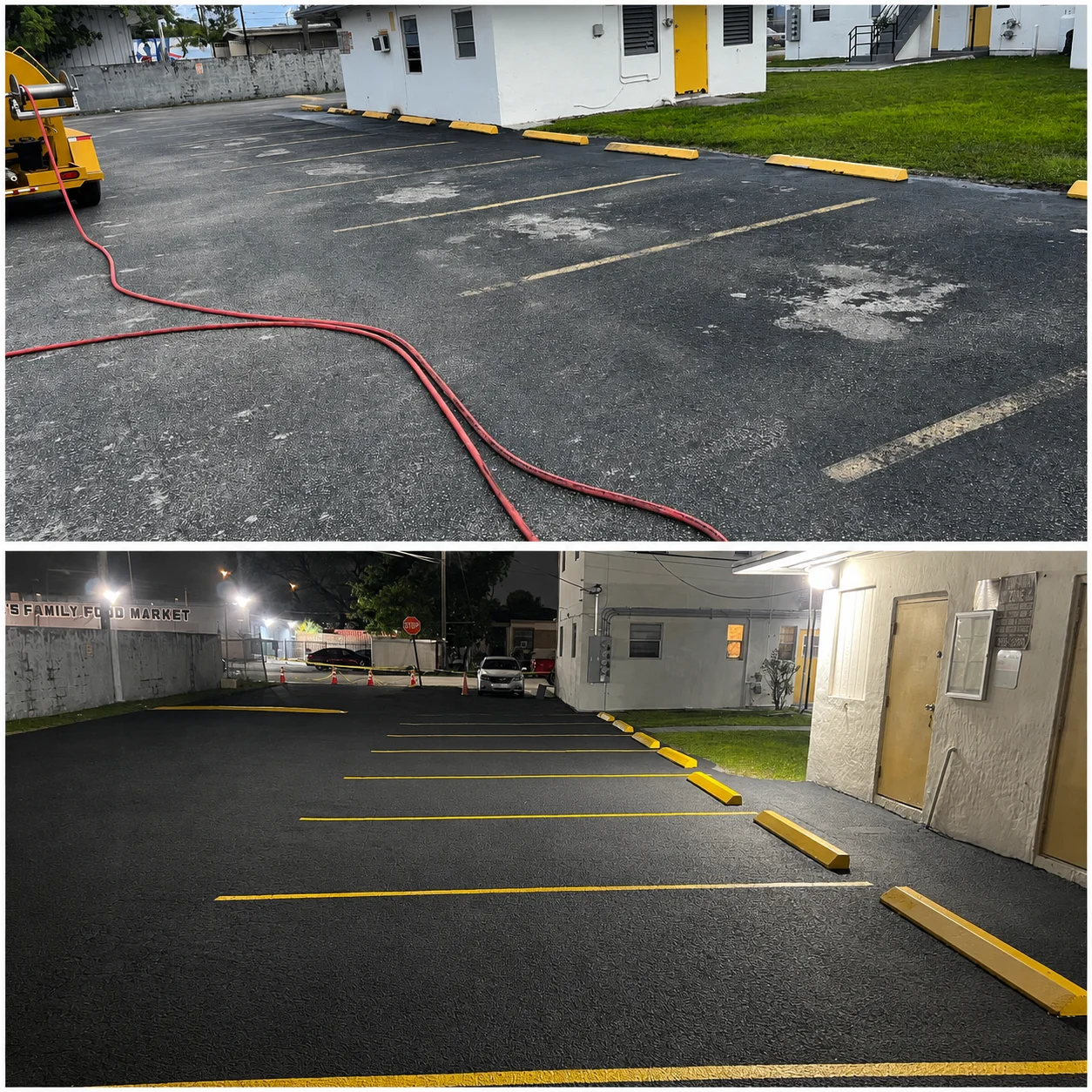
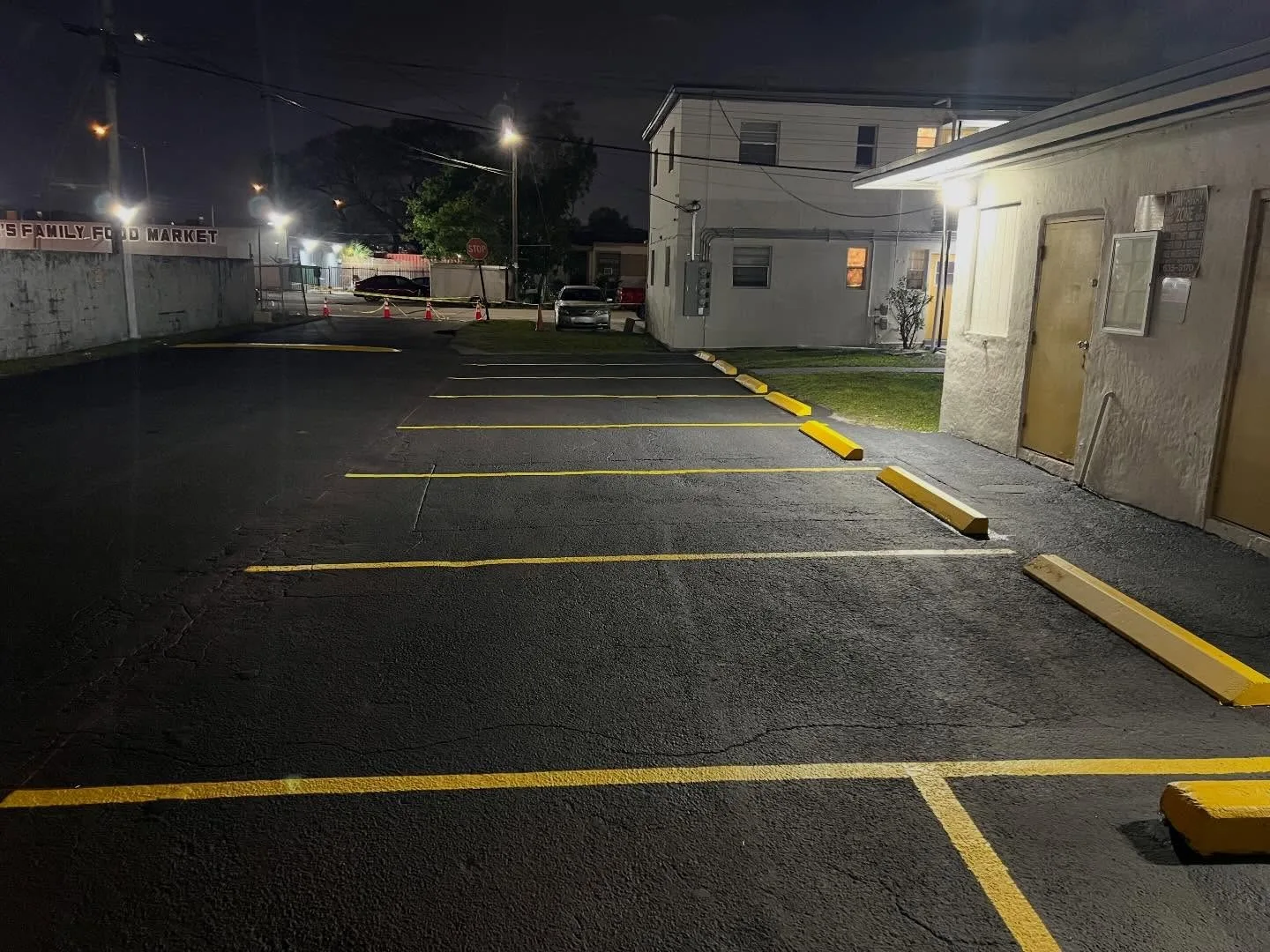
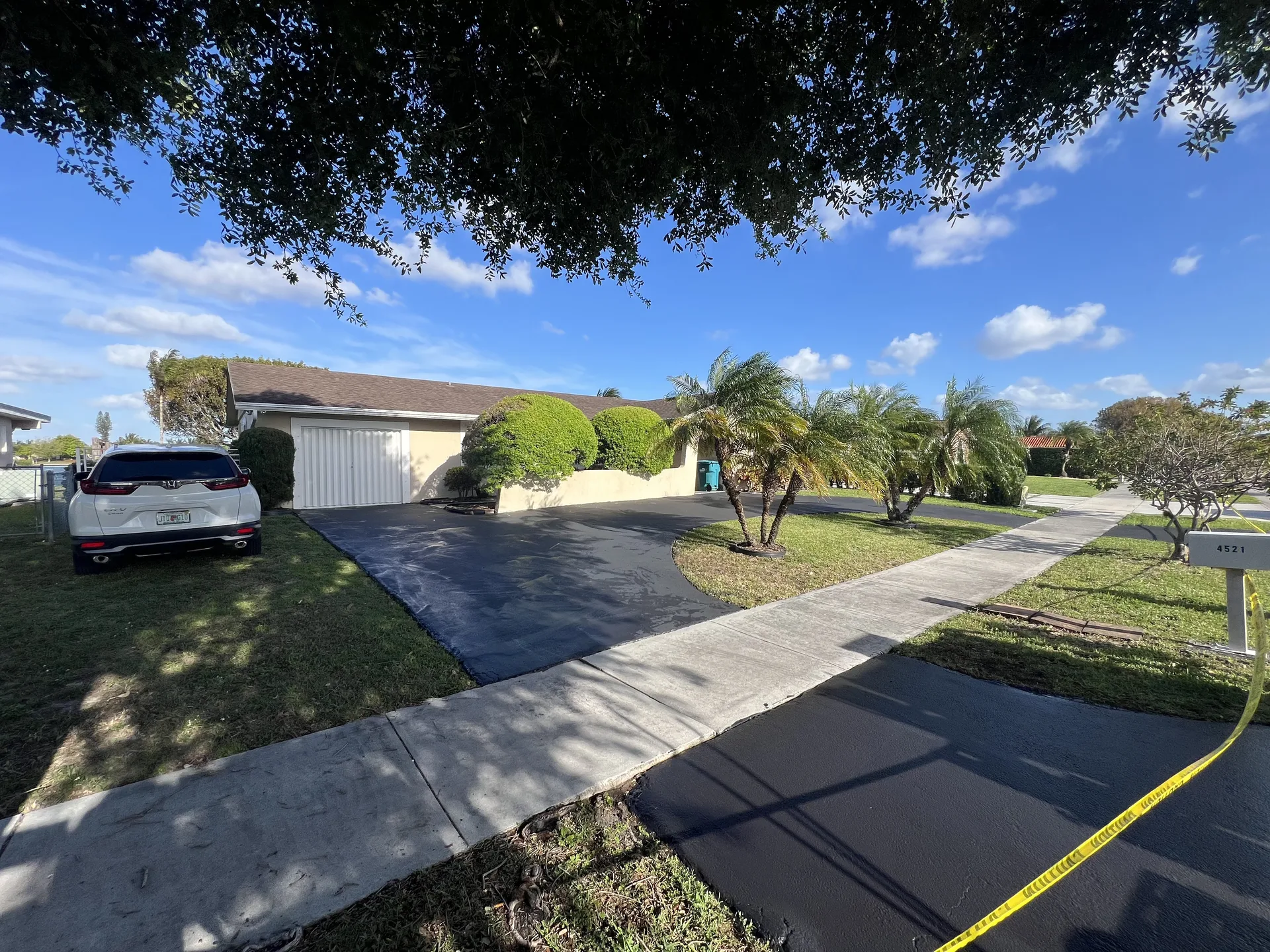
A sealed and striped commercial lot in Cutler Bay.
Shallow Water Table and Limestone Base
South Miami-Dade sits on one of the shallowest and most responsive aquifers in the country. The U.S. Geological Survey describes the Biscayne aquifer as highly permeable limestone and sandstone with its top at or near land surface through much of its mapped area, and notes that the Miami Oolite, a very porous limestone, is present at the surface throughout much of Dade County. It also reports that during a heavy rain event in Miami, eleven inches of rainfall in 4 hours produced a 4.5-foot rise in the water level in a monitored well within a few hours.
For pavement, a high water table means the base can stay wetter, and wetter means weaker. When storms and flooding raise groundwater, a base already weakened by cracks has less strength under traffic. This does not mean asphalt cannot last here; it means drainage, base preparation and crack sealing matter more than they would in a dry climate. When potholes keep coming back in the same spot, a weak or saturated base is a likely reason, and a deeper repair or an overlay is worth pricing.
Traffic Loads: Cracks From Repeated Stress
Cars are light but trucks are not, and the repetition adds up. The FHWA defines fatigue, or alligator, cracking as a series of small, jagged, interconnecting cracks caused by failure of the asphalt surface under repeated traffic loading. Delivery lanes, dumpster pads, entrances and turning areas take the most punishment. When these areas fail, filling the cracks is a temporary measure; cut-out patching, or resurfacing of the area, is the repair. Lots with heavy truck use often fail first at those spots even when the rest of the lot is fine.
Drainage and Ponding
Water that cannot leave the lot sits on it. Ponding keeps the surface and the base wet, speeds up breakdown around it, and makes edges ravel. Low spots can come from settlement, from original grading, or from patches that were placed slightly high or low. Before spending on surface repair, mark where water sits after a storm. Sometimes a patch or overlay can restore grade; sometimes a drain, inlet or grade problem has to be corrected first. See our guide to parking lot repair for how to triage these.
Tree Roots and Edge Conditions
Roots grow where moisture and air are found, which is often just under pavement, and they lift the surface as they expand, which cracks it. The edges of a lot are another weak spot because they have less support and take on runoff. Patching and overlay can repair the surface, but they will not stop a root from growing, so decisions about large trees near pavement belong with an arborist and the property owner.
What Can and Cannot Be Prevented
- Can be slowed: surface oxidation, through timely sealcoating; water entry, through crack filling; faded markings, through restriping.
- Can be repaired: isolated potholes, failed spots, and worn surfaces by patching and overlay.
- Cannot be fixed by surface work: a weak base across the whole lot, serious drainage grade problems and active root heave. These need a deeper repair or a plan.
Why the Order of Repairs Matters
Because these causes chain together, the repair sequence matters as much as the repair itself. Fill cracks first, so water stops entering. Patch failed areas next, so the surface is uniform. Sealcoat sound pavement to slow further surface aging, then restripe so the layout and accessible spaces are clear. Skipping a step, such as sealing over open cracks, lets the same cause keep working underneath. If a large share of a lot needs patching, that is a signal to price a resurfacing instead, and an estimate that compares both options is more useful than one that only quotes the cheapest.
What a Good Inspection Looks For
- Surface condition. Color, roughness, loose stone.
- Cracks. Width, direction and whether they connect into a pattern.
- Failed areas. Potholes, soft spots, sunken or raised sections.
- Water. Where it sits after rain and where it leaves.
- Edges and trees. Crumbling edges and root lift.
- Markings and accessibility. Faded lines, accessible spaces and trip hazards.
Not Sure Which Cause Is at Work on Your Lot?
Bull's Eye offers sealcoating, hot-pour rubberized crack filling, pothole repair, overlay, new paving and striping, so the repair can match the cause. We are based at 8260 SW 184th St in Cutler Bay and serve Palmetto Bay, South Miami Heights, Goulds, Naranja, Princeton, Perrine, West Perrine, Richmond Heights and Richmond West. See our service areas. Call (305) 710-4512 or request the free on-site estimate. More answers are in our FAQ, and our sealcoating vs overlay vs repaving guide covers the decision itself.