

Most manufacturers and contractors suggest sealcoating every two to three years, but that is a rule of thumb, not a deadline. The better test is the condition of the surface: seal when asphalt has started to dry out, fade and wear, not on a fixed date. New pavement should wait, and pavement with structural damage needs repair before sealer will help.
The Short Answer
Plan on sealcoating roughly every two to three years, then adjust to what the pavement looks like. SealMaster, a major sealer manufacturer, recommends sealing every two to three years to extend pavement life, and notes its general guidance of about every three years for protection and appearance. Those numbers describe an average case. A shaded residential driveway with two cars and a high-traffic commercial lot in full sun do not age at the same speed. If you are weighing sealcoating against bigger repairs, our guide to sealcoating vs overlay vs repaving covers when sealer is the wrong tool.
Why “Every 2 to 3 Years” Is a Rule of Thumb
A fixed interval is easy to remember, but sealcoat wears at different rates depending on the conditions on your property. SealMaster itself lists traffic volume, climate and the quality of the original application as factors, and says high traffic wears sealer faster, with a third coat recommended in high-traffic situations. Sealing too often is also a real problem: sealer builds up, and some contractors caution that stacking coats on pavement that does not need it can lead to cracking or peeling. So the question is not how many years have passed, it is what the surface is telling you.
- Traffic. Drive lanes, entrances and turning areas on a commercial lot wear faster than parking stalls or a quiet driveway.
- Sun exposure. Open pavement in full sun oxidizes faster than shaded areas.
- Application quality. Number of coats, sealer mix and application rate all affect how long the finish lasts.
- Prior condition. Pavement that was cracked and unrepaired when sealed will show wear sooner.
Signs It Is Time to Sealcoat
Look for surface aging that has begun but not yet turned into structural damage. The Asphalt Institute recommends sealing once pavement has become dry and brittle with age, to seal small surface cracks and voids and to inhibit raveling, which is the loss of surface stone.
| What you see | What it means | Action |
|---|---|---|
| Faded, gray surface instead of deep black | Binder at the surface is oxidizing | Good time to seal |
| Rough, sandy feel; loose stone on the surface | Early raveling | Seal soon, before more stone is lost |
| Hairline and small cracks | Water can reach the base | Fill cracks, then seal |
| Oil and fuel stains | Petroleum softens asphalt | Spot treat and prime, then seal |
| Dark, smooth, tight surface with no cracks | Healthy pavement | Wait |
| Alligator cracking, sinking, potholes | Base or structural failure | Repair or resurface; sealer will not fix it |
How Long to Wait on New Asphalt
New asphalt should not be sealed right away, and the sources give different numbers because they answer different questions. The Asphalt Institute says a well-designed and constructed low-traffic pavement, such as a driveway or parking lot, should not need sealing for approximately 2 to 5 years, depending on climate and the quality of the original work. SealMaster, writing about how soon sealer can go on, says new asphalt should cure a minimum of 30 to 60 days and be free of oils before it is sealed. The first is about when sealing becomes worthwhile, the second about the earliest it is physically possible. A sensible approach is to let new pavement cure, watch it, and seal when it starts to dry and fade rather than on the calendar.
What Sun and Rain Do to Asphalt in South Florida
South Florida pavement faces strong sun year-round and a long, wet season, and both work on the surface binder. UV and heat dry out and oxidize the asphalt binder at the surface, which is the fading and roughness described above. Then water gets to work: the National Weather Service in Miami defines the wet season as roughly May 15 to October 15 and says it brings about 60 to 70 percent of the year's rain. Any open crack takes in that water. That is why filling cracks before the wet season, and keeping the surface sealed, matters here. Manufacturer guidance on frequency is mostly written for regions with winters, and SealMaster notes that freeze and thaw cycles speed up wear in cold regions; South Florida does not have that, but it does have sun and heavy rain. We could not find a manufacturer or agency figure specific to South Florida, so treat any single number for Miami-Dade as an estimate.
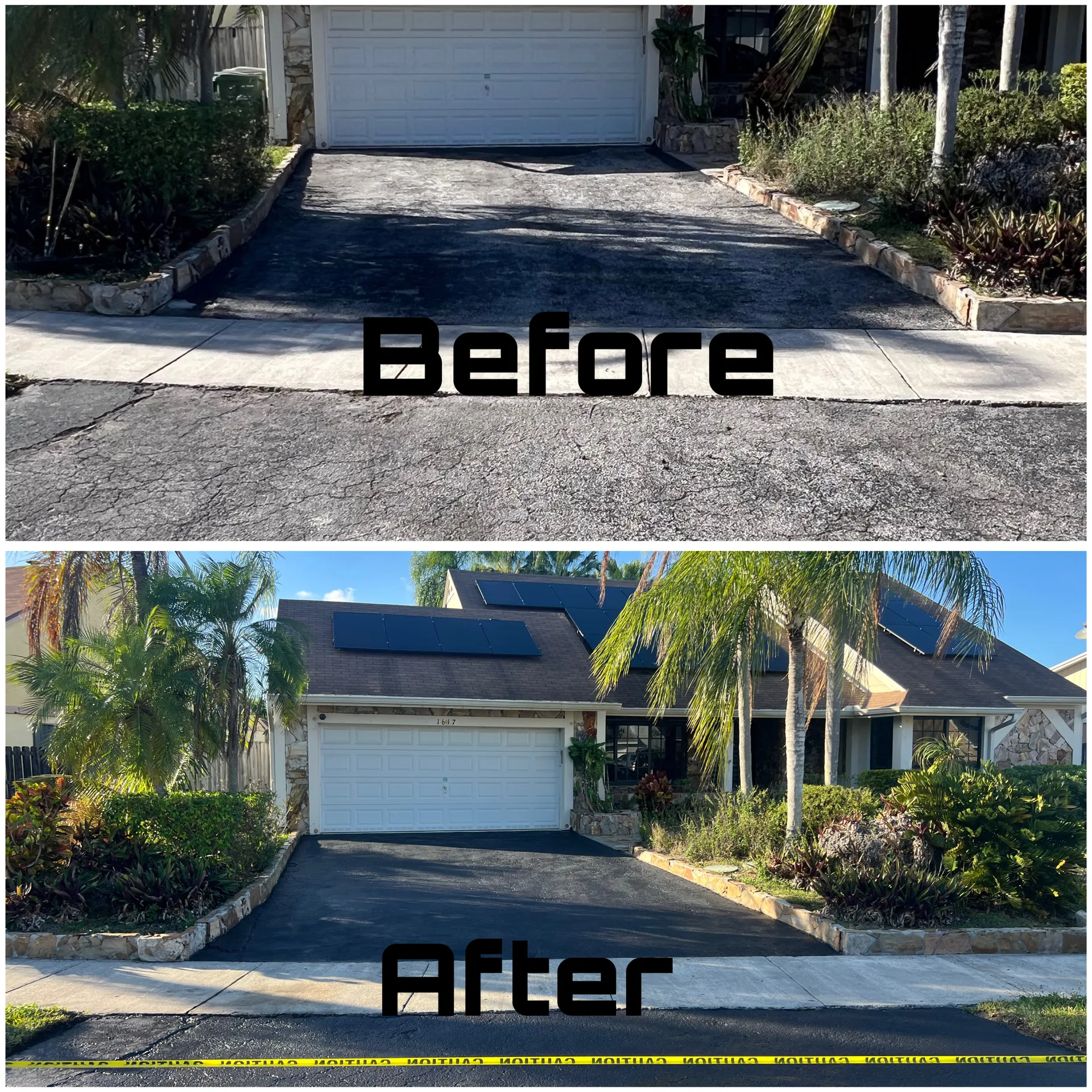
Before and after: a faded asphalt driveway and the same driveway sealcoated.
Driveways vs Parking Lots
A residential driveway and a commercial or HOA lot follow the same logic with different pressures. Driveways usually carry light traffic, so the interval is often set by sun exposure and appearance. Commercial lots carry more vehicles, turning, trucks and dumpster pickup, and benefit from walking the lot once a year to catch cracks and oil spots early. Property managers and boards often schedule sealcoating around reserve planning, and Bull's Eye works with HOA boards and property managers and can phase work or schedule it overnight or on weekends. See commercial parking lot sealcoating or driveway sealcoating for each.
A Simple Yearly Check
Instead of counting years, look at the pavement once a year, ideally just after the wet season ends in mid-October. Walk the surface and note faded areas, new cracks, oil spots and places where water stands after rain. A short list like this turns a vague schedule into a decision. If the list is short and the surface is dark and tight, wait another season. If cracks have opened and the surface is gray and rough, plan the work for the dry months, when forecasts are easier to trust.
- Photograph the problem areas. Same spots each year make changes obvious.
- Fill new cracks promptly. Open cracks let water reach the base, especially in the wet season.
- Clean oil and fuel spots. Petroleum softens asphalt and stops sealer from bonding.
- Decide on sealing. Seal when fading and roughness are widespread, not when only a few spots look worn.
- Re-mark after sealing. Fresh sealer covers old lines, so plan restriping with the job.
What If You Waited Too Long?
Missing the window is common, and the fix depends on how far the surface has gone. If the pavement is faded and has small cracks, fill the cracks and seal. If it has alligator cracking, soft spots or potholes, sealing will not help and repair or resurfacing is the better use of money. Reflecting that, Bull's Eye fills cracks before sealcoating and applies two coats, and pothole repair and patching and overlay are available when sealer is not enough.
Questions to Ask Before You Book
- Does my pavement need sealing now, or can it wait another season?
- Will cracks be filled first, and how?
- How many coats will be applied, and is the sealer mixed to the manufacturer's instructions?
- When will work be scheduled around rain, and what is the plan if a storm moves in? See the cure time and rain guide.
- How long before vehicles can use the surface?
Get a Second Set of Eyes
Call (305) 710-4512 or request the free on-site estimate to have your pavement looked at. Bull's Eye is at 8260 SW 184th St in Cutler Bay and serves Palmetto Bay, South Miami Heights, Goulds, Naranja, Princeton, Perrine, West Perrine, Richmond Heights and Richmond West. Hours are Monday to Friday 7 to 5 and Saturday 8 to 12. See the FAQ for more answers.