

Parking lot striping cost depends mostly on how many stalls and how many linear feet of line the lot has, whether you are repainting an existing layout or creating a new one, and how many ADA items, signs and extras are added. Typical industry ranges are published below, labeled as ranges and not as a quote. For a lot in Miami-Dade, the figure that matters is the one written after the lot is measured.
Typical Industry Ranges (Not a Quote)
Striping prices are published per stall, per linear foot and per lot, and the ranges are wide because lots differ so much. These figures are typical industry ranges from contractor cost guides published in 2026 that we opened and checked in October 2026. They are not Bull's Eye prices and not a quote. We found no Miami-Dade-specific price study; the one Florida contractor page we found (Lakeland) lists $3 to $6 per stall, at the bottom of the national range.
| Item | Typical industry range | What moves it |
|---|---|---|
| Restriping an existing layout, per stall | Roughly $3 to $20 per stall; most guides say about $4 to $10 | Stall count, paint, lot size (bigger lots cost less per stall), contractor minimums |
| Restripe of a typical commercial lot, whole job | Roughly $300 to $2,000; small lots often $300 to $1,200, with larger lots higher | Stall count, extras, minimum charge |
| New layout versus restripe | Roughly 20 percent to 60 percent more than a restripe | Measuring, layout and chalking labor, sometimes a second coat |
| Standard 4-inch line, per linear foot | Roughly $0.20 to $0.50; up to about $1.00 in the widest quoted ranges | Paint grade, lot condition |
| ADA stall with symbol and hatching | Roughly $25 to $60 each; one guide lists $75 to $150 for a full blue-field stall | Symbol only, or symbol, hatching and blue background (signs are separate) |
| Directional arrow or stencil | Roughly $8 to $40 each | Standard stencil or custom artwork, restripe or new |
| Crosswalk | Roughly $50 to $100 each | Width and length |
| Curb painting, including fire lane curbs | Roughly $0.50 to $4 per linear foot; lettering extra | Footage, stenciling, restripe or new |
| Mobilization and minimum charge | Mobilization about $150 to $350; job minimums about $250 to $500 | Small lots are billed at the minimum rather than per stall |
Where the Sources Disagree, and Why
- Per stall. Floors run from $3 to $6 (Lakeland, Florida) up to $5 to $20 (two guides). The high end counts double-line stalls, small lots and minimums, and the low end assumes single-line stalls on a larger lot.
- New-layout premium. Guides say 20 to 30 percent, 20 to 50 percent and 40 to 60 percent more. The spread reflects whether a second coat on new pavement is included.
- ADA stalls. Most guides list $25 to $60. The higher $75 to $150 figure from one guide includes the blue background, so ask whether the quote is symbol only.
- Per linear foot and curb work. Per-foot paint prices cluster at $0.20 to $0.50, but thermoplastic is quoted higher, and curb painting ranges from $0.50 to $4 depending on whether it is a plain restripe or a lettered fire lane.
- Region. Most guides come from Texas, Connecticut and national averages. Only one Florida page was found, so local labor and wet-season scheduling can move a Miami-Dade bid either way.
What Drives Striping Cost
- Stall count and total line length. This is the primary driver. More stalls means more line, more paint and more time. Angled stalls use more line than 90-degree stalls.
- Restripe vs new layout. Repainting existing lines follows marks already on the pavement. A new layout, such as on fresh paving or a reconfigured lot, means measuring, laying out and chalking every line first, which takes more labor.
- ADA items. Accessible stalls need a symbol, an access aisle and a sign, and the layout has to follow the accessibility standards that apply to your property. See ADA handicap striping and signage and the ADA parking lot requirements guide. Not legal advice; confirm requirements with your local authority.
- Signs. Accessible stalls must be identified by signs, and extra signs for no parking, loading or reserved spaces are separate items. See parking lot sign installation.
- Wheel stops and curbs. Installing wheel stops is hardware plus labor, and painting curbs, including fire lane curbs, is priced by the foot. See wheel stop installation, curb painting and fire lane painting. Fire lane markings follow the local fire authority, so see the fire lane marking rules guide.
- Paint type. Water-based and solvent-based traffic paints are the common choices. Published guides put standard paint at roughly one to two years of life in busy lots (one lists 6 to 18 months for water-based), while thermoplastic is quoted at 3 to 5 years and about 2 to 4 times the cost of paint. Ask what product is specified.
- Surface condition. Dirt, oil, faded old paint, cracks and potholes can add cleaning or repair work, and lines last longer on sound pavement.
- Access and schedule. A lot that must stay open during business hours may need night or weekend work, which affects the price. Bull's Eye schedules commercial work in phases, overnight or on weekends.
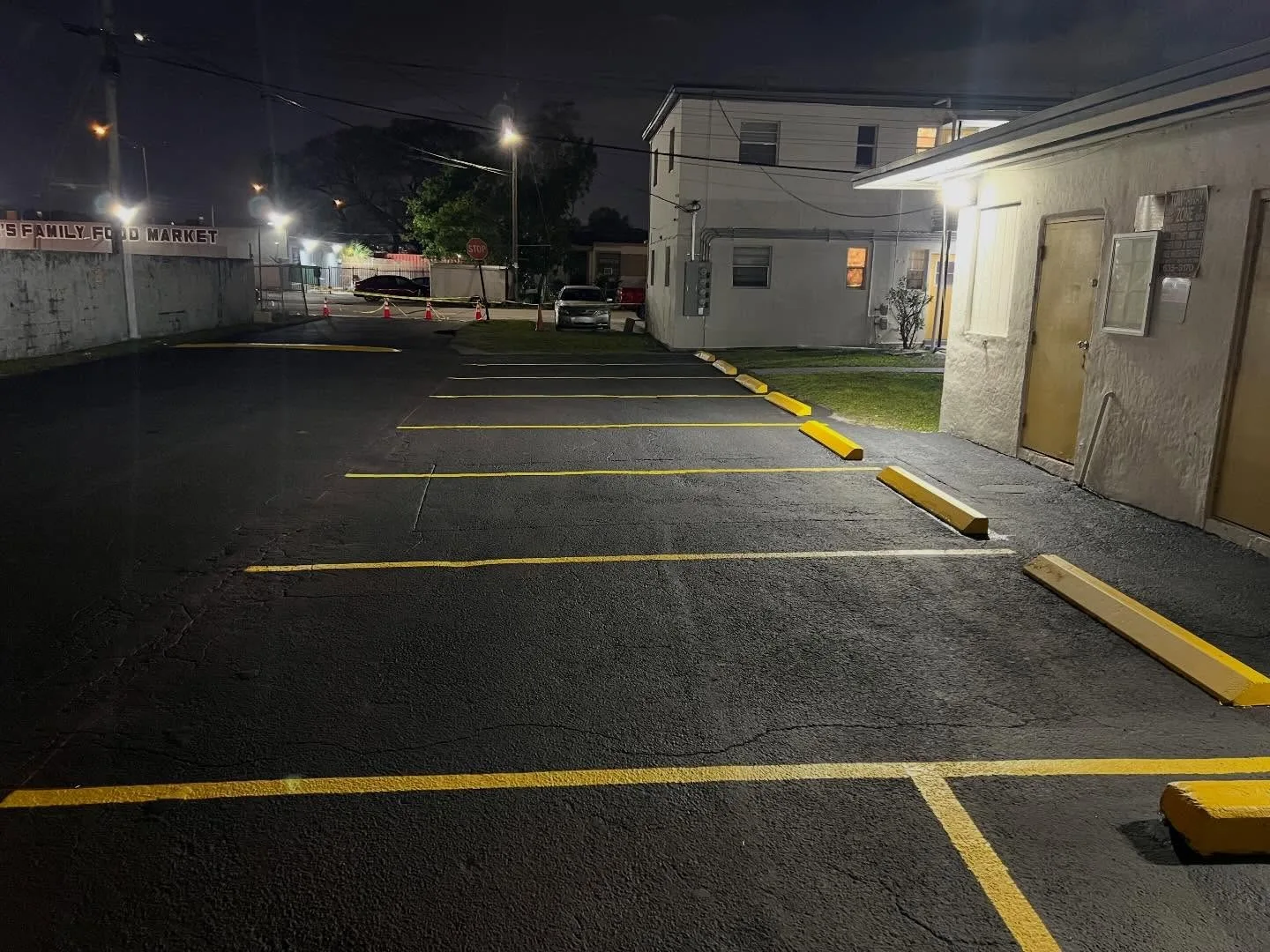
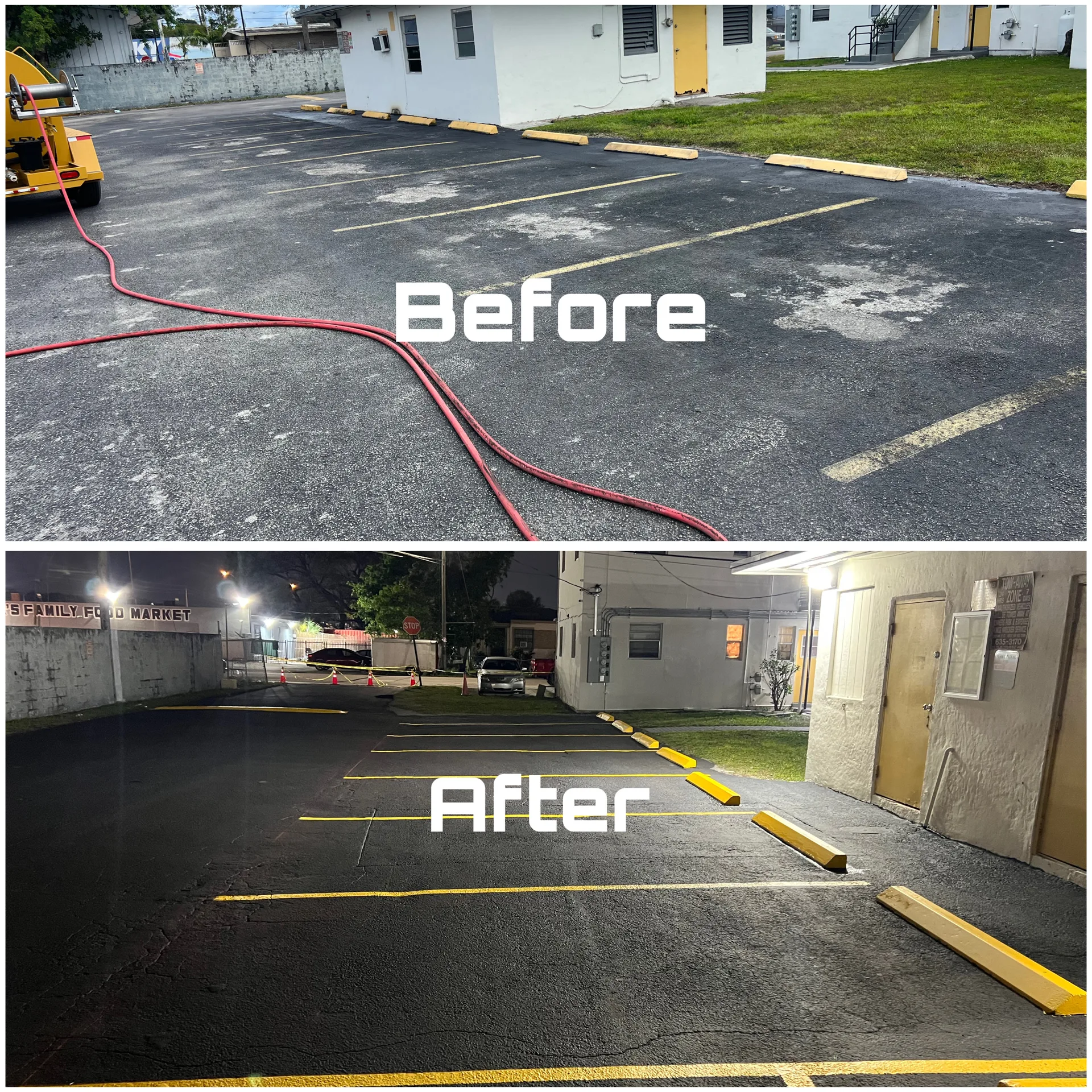
Fresh stall striping with wheel stops installed.
Restripe vs New Layout: Which One Are You Pricing?
Ask for the quote to say which one it is, because the two are priced differently and comparing them is the most common bid mistake.
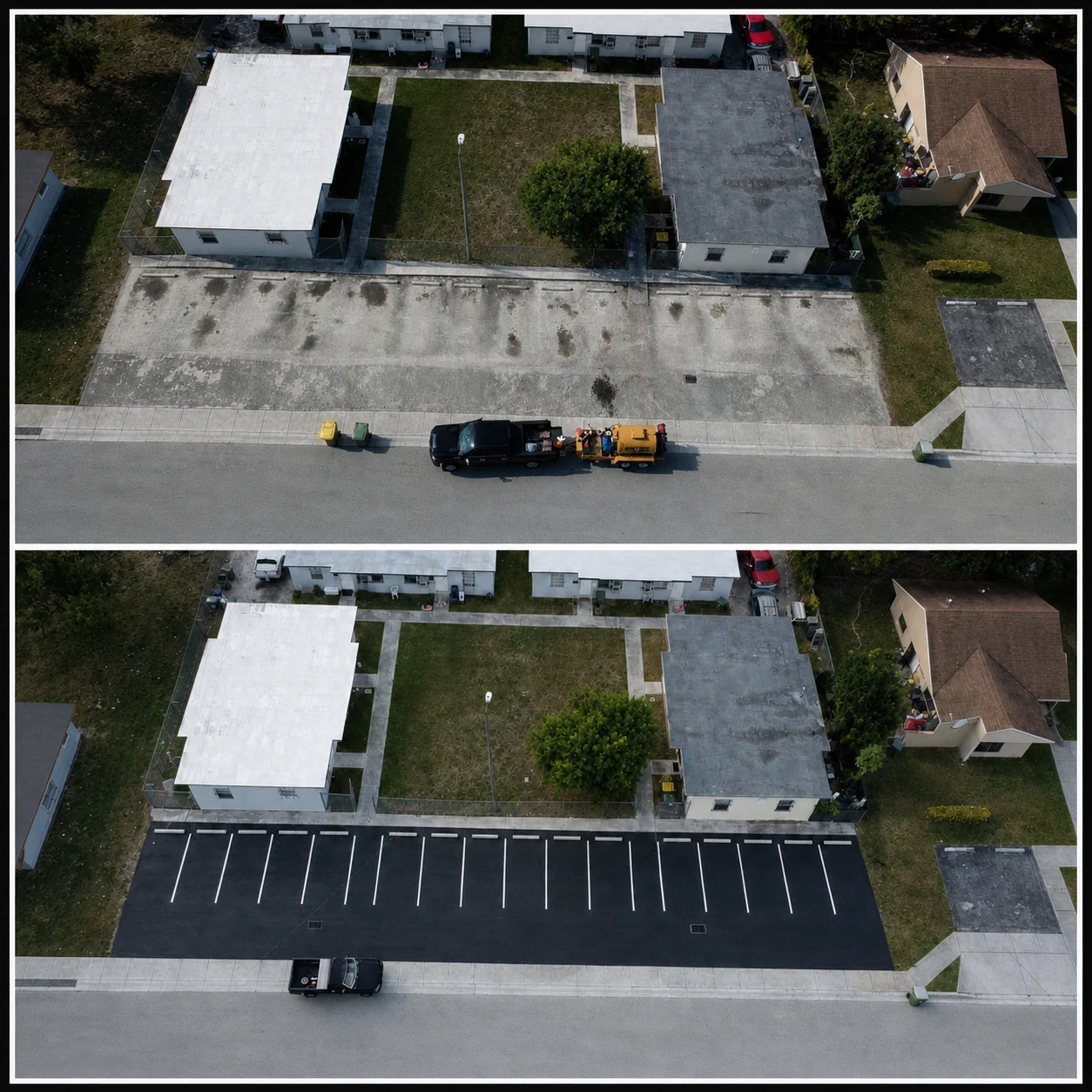
- Restripe. The existing layout stays. This is the lowest-cost option and fits lots where lines have faded but the stall pattern is still right.
- New layout. The lot is re-measured and marked fresh, which fits newly paved or overlaid pavement, a change in stall count, or a lot being reconfigured for ADA or fire access.
- Restripe with corrections. If existing marks are wrong or non-compliant, a straight repaint may only copy the problem. The U.S. Access Board says refreshing existing striping in place is typically normal maintenance, while resurfacing, resealing or adding spaces is an alteration that must include accessible spaces. An older Department of Justice brief (archived) goes further and says a business that restripes a parking lot must provide accessible spaces as the ADA Standards require. The two sources differ, so this is not legal advice; confirm with your local authority before assuming either applies.
Sealcoating and Striping Timing
If a lot will be sealcoated, striping belongs after the sealer, not before, because sealer covers old lines. That makes the order of work part of the bid. Bull's Eye can sealcoat and stripe in the same visit. Fresh sealer needs to be cured enough to take paint, so ask any contractor how that is scheduled. For the sealcoating side of the budget, see the sealcoating cost guide.
How to Compare Parking Lot Striping Bids
| Ask or check | Why it matters |
|---|---|
| Restripe or new layout? | The two are priced differently and are not comparable |
| Stall count and linear feet | A stated count lets you compare price per stall |
| ADA stalls, symbols, aisles and signs | Included or extra, and how many of each |
| Arrows, stop bars, crosswalks, fire lane curbs | Often quoted as separate items |
| Paint product and coats | Traffic paint, not general-purpose paint |
| Cleaning or prep | Whether old lines are cleaned or ground, and loose debris removed |
| Wheel stops and signs | Hardware, installation and anchoring, itemized |
| Schedule and closures | Night or weekend work, how stalls are blocked off and cure time |
| Insurance | Proof of general liability coverage. Bull's Eye carries it, with proof on request. |
| Minimum charge | A small lot may be billed at a minimum rather than per stall |
A bid that is well below the others is worth a question, not automatic trust. Look at the paint specified, the scope and the ADA details as well as the price, because a cheap job that fades quickly or misses an ADA detail can end up costing more.
A Worked Example of How the Math Works
The easiest way to see why bids differ is to walk through a hypothetical lot. This is an illustration of how the line items add up, not a price for any real property.
Take a lot with 60 stalls. A restripe bid might list the stall lines, a handful of accessible stalls with symbols and aisles, a few arrows and stop bars, and perhaps a stretch of fire lane curb. Each item is counted and priced on its own. A second bid for the same lot might lump everything into one sum and leave out the signs, which is why the two totals look close until you compare scope. A third might price a new layout because the contractor assumed the lot was being reconfigured. All three can be honest, and none can be compared until each one states the same stall count, the same extras and the same type of job.
That is why a written scope with counts matters more than the bottom-line number. When two bids are far apart, line them up item by item and find the line that explains the difference. Often it is one of four things: restripe versus new layout, accessible items included or not, signs and wheel stops included or not, or prep work included or not.
Common Mistakes That Raise the Final Bill
- Striping before sealcoating. Sealer covers new lines, so the work is paid for twice.
- Repainting a wrong layout. Copying faded lines that were never correct preserves the problem. A walk-through of the accessible stalls and fire lane before painting is cheaper than redoing them.
- Using the wrong paint. Ask for a paint made for traffic marking, not general-purpose paint.
- Skipping the repair list. Potholes and cracked areas under new lines show up again within months. See pothole repair and patching and crack filling.
- Not planning closures. Paint needs time before cars return. Residents and tenants should be told which sections are closed and when.
What Property Managers Should Have Ready
- An approximate stall count and whether any lines will change.
- Any existing site plan or past striping plan.
- Which stalls are accessible, reserved or loading.
- When the lot can be closed, and which sections can be closed at a time.
- Whether sealcoating, crack filling or patching is also planned.
Having this ready makes the on-site estimate faster and the quote more accurate. See also parking lot striping for the services Bull's Eye offers.
Serving Cutler Bay and Nearby Communities
Bull's Eye is based at 8260 SW 184th St in Cutler Bay and serves Palmetto Bay, South Miami Heights, Goulds, Naranja, Princeton, Perrine, West Perrine, Richmond Heights and Richmond West. Not sure if you are in range? Just call.
Get a Free On-Site Estimate
Call (305) 710-4512 or request your free on-site estimate. Hours are Monday to Friday 7 to 5 and Saturday 8 to 12. For quick answers, see the FAQ.